


 Distributors
  SDS Download
  Contact
 Partner Login
Enter your username and password here on order to log in on the partner portal:
No registered partner yet?
Register nowWhy Choose a Bucket Filling Machine?
Why Choose a Bucket Filling Machine?
Manufacturers are under pressure to fill faster, reduce waste, and maintain consistent product weight. A Bucket Filling Machine can address these needs with controlled dosing, repeatable cycles, and cleaner material handling. It is especially valuable for paints, coatings, chemicals, food ingredients, and construction materials. Each bucket should leave the line with the same fill level. Small differences become expensive over thousands of units.
Industry data supports this investment. PMMI’s U.S. Packaging Machinery Market reports have placed annual machinery shipments above $10 billion, reflecting continued spending on automation and production reliability. Mordor Intelligence also identifies automation, labor shortages, and improved filling accuracy as important growth factors in the global filling equipment market. These reports do not guarantee savings for every factory. Product viscosity, container shape, cleaning requirements, and operator training still matter.
Jorge Izquierdo, Vice President of Market Development at PMMI, has stated, “Automation is becoming a strategic response to labor availability, not merely a productivity upgrade.” That principle fits bucket filling operations closely. A modern Bucket Filling Machine can reduce manual scooping, limit spillage around the rim, and create a clearer production record. Still, automation is not magic. Poor calibration can produce expensive errors. A practical evaluation should examine accuracy, changeover time, maintenance access, and integration with conveyors, capping systems, and checkweighers. The right machine is not always the fastest one. It is the one that remains dependable during a busy, imperfect production shift.
What Is a Bucket Filling Machine?
Why Choose a Bucket Filling Machine?
What Is a Bucket Filling Machine?
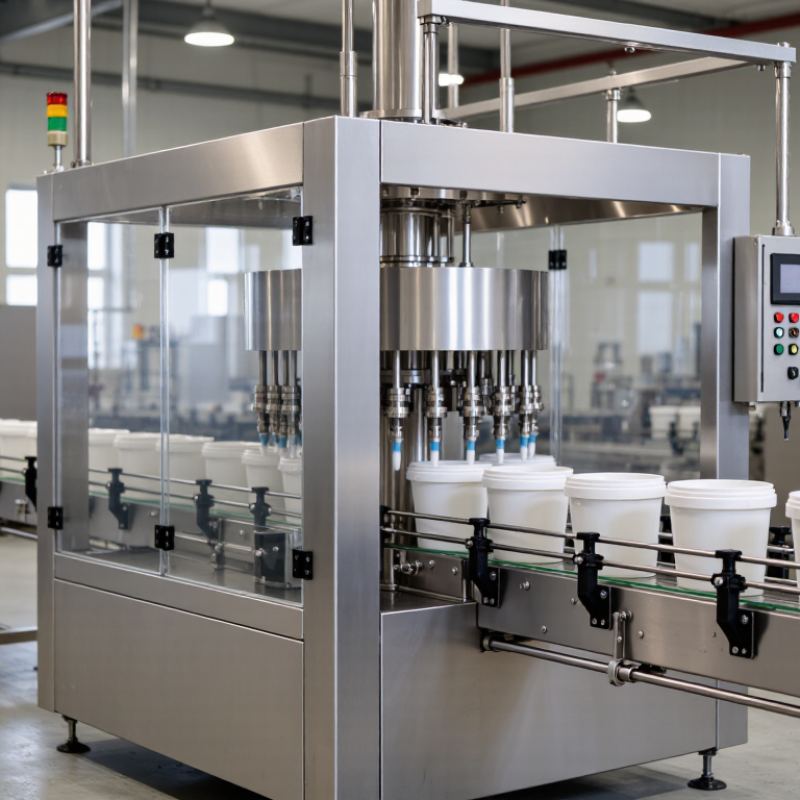
A bucket filling machine is industrial equipment that measures and dispenses products into rigid buckets. It can handle powders, granules, pastes, or liquids, depending on its design. Common systems use augers, gravity fillers, pumps, or net-weigh mechanisms. Load cells can check each bucket before discharge. A control panel then adjusts the next filling cycle.
The machine usually includes a product hopper, filling head, bucket conveyor, and sealing station. Operators place an empty bucket beneath the nozzle. The system fills it, checks its weight, and moves it forward. This reduces spills around the rim and limits repetitive lifting. Fortune Business Insights estimated the global packaging machinery market at USD 54.02 billion in 2023. The report projects USD 69.22 billion by 2030. That growth reflects wider investment in automated packaging, not bucket fillers alone.
Speed is only one reason to choose this equipment. Consistency matters more when products have different densities. A faster cycle can still create underfilled buckets. That needs honest testing. Product dust, sticky surfaces, and uneven buckets may reduce accuracy. The right machine must match the material, target weight, and production space.
Tips: Test your real product before purchase. Compare five consecutive fills, not one. Check cleaning access, scale calibration, and changeover time. Keep records of rejected buckets. Small losses become expensive over a long shift.
Why Choose a Bucket Filling Machine? - What Is a Bucket Filling Machine?
| Evaluation Dimension | Manual Filling | Semi-Automatic Bucket Filling Machine | Automatic Bucket Filling Machine |
|---|---|---|---|
| What it is | An operator measures and transfers product into each bucket. | A dosing system fills the bucket after an operator positions it under the filling head. | An integrated line automatically feeds, fills, weighs, closes, and conveys buckets. |
| Typical products | Small batches of powders, granules, liquids, pastes, or viscous products. | Paint, coatings, adhesives, food ingredients, chemicals, detergents, and construction materials. | High-volume liquid, powder, granular, and semi-liquid products requiring repeatable production. |
| Common bucket sizes | Approximately 1–25 L, depending on operator handling and product weight. | Approximately 1–25 L; larger sizes may be possible with suitable equipment. | Approximately 5–30 L is common in industrial packaging; the actual range depends on the line design. |
| Typical output | About 10–60 buckets per hour. | About 60–300 buckets per hour. | About 200–1,200 buckets per hour, depending on product, fill volume, and machine configuration. |
| Filling accuracy | Often around ±1–3%, with variation caused by operator technique and product properties. | Commonly around ±0.5–1%, when correctly calibrated and matched to the product. | Commonly around ±0.1–0.5% for weight-based systems; actual accuracy depends on the load cell, product, and target weight. |
| Labor requirement | High; one or more operators usually handle measuring, filling, and movement. | Medium; an operator typically loads containers and starts or monitors each filling cycle. | Low per unit; operators mainly supervise the line, replenish materials, and perform quality checks. |
| Production consistency | Highly dependent on operator skill, fatigue, and working conditions. | More consistent because the dosing cycle and target quantity are controlled. | Highly consistent when the product feed, sensors, and control settings are stable. |
| Product waste | Usually higher because of overfilling, spillage, and manual transfer. | Usually lower because the filling quantity is controlled by a timer, flow meter, or weighing system. | Generally lowest when the machine uses accurate weighing, automatic shutoff, and optimized product feeding. |
| Best production scale | Product trials, custom orders, seasonal production, and very low-volume operations. | Small- to medium-scale production with several product or container changes. | Medium- to large-scale production with stable demand and repeatable packaging formats. |
| Changeover flexibility | Very high; changes can be made without machine adjustments. | High; many systems allow recipe, fill-volume, or nozzle adjustments. | Medium to high; changeover may require parameter updates, tooling changes, and cleaning. |
| Space requirement | Minimal. | Typically compact, often requiring approximately 1–3 m² of working space. | Larger footprint, commonly requiring approximately 5–20 m² for the filling and conveying section. |
| Operating principle | Manual volume or weight measurement. | Timed, volumetric, flow-meter, auger, piston, or weight-based dosing. | Automated container handling combined with volumetric or gravimetric dosing and programmed controls. |
| Main advantages | Lowest initial cost, simple operation, and maximum flexibility for irregular jobs. | Better accuracy and productivity without the full cost or complexity of a complete automated line. | High throughput, repeatable filling, reduced labor per bucket, and easier production monitoring. |
| Primary limitations | Slow output, inconsistent fill levels, and greater exposure to spills or ergonomic strain. | Still requires operator involvement and may not meet high-volume production targets. | Higher investment, greater maintenance requirements, and less economical for very small batches. |
| Why choose a bucket filling machine? | Suitable when flexibility is more important than speed or precision. | A practical choice for improving accuracy and output while retaining operator control. | A strong choice when production volume, filling consistency, labor efficiency, and waste reduction are priorities. |
Note: The performance figures are typical planning ranges rather than universal specifications. Actual results depend on product viscosity, particle size, flowability, foaming behavior, bucket dimensions, target fill weight, and machine configuration.
