Why Choose a Vintage Shoe Cabinet for Your Home?
A hallway often reveals how a home works: shoes gather beside the door, while narrow walkways make mornings feel rushed. A Vintage Shoe Cabinet can give that daily clutter a defined place, while adding the warmth of aged wood, shaped legs, or antique-style hardware. It is practical furniture, but also a visible part of the room.
The 2024 Houzz & Home Study reported a median U.S. renovation spend of $24,000 in 2023. The study does not measure shoe storage specifically, so that figure should not be treated as evidence of demand for vintage cabinets. It does, however, show that homeowners continue to invest in their spaces. For buyers, the more useful questions are personal: How many pairs need storing? Is the entryway well ventilated? Will the cabinet’s depth leave enough room to pass comfortably?
Details matter. Measure the wall, check door clearance, and inspect joints, hinges, and the cabinet’s base before buying. Older finishes may show scratches or uneven color; those marks can add character, but they may also need careful cleaning or repair. A cabinet with adjustable shelves can accommodate boots and changing footwear, while ventilated panels may help air circulate. Small choices count.
Not every vintage piece fits every home. That deserves thought. Choosing carefully can turn an awkward corner into useful storage without making the entryway feel crowded. A Vintage Shoe Cabinet is most successful when its condition, dimensions, and style suit the way people actually use the space.
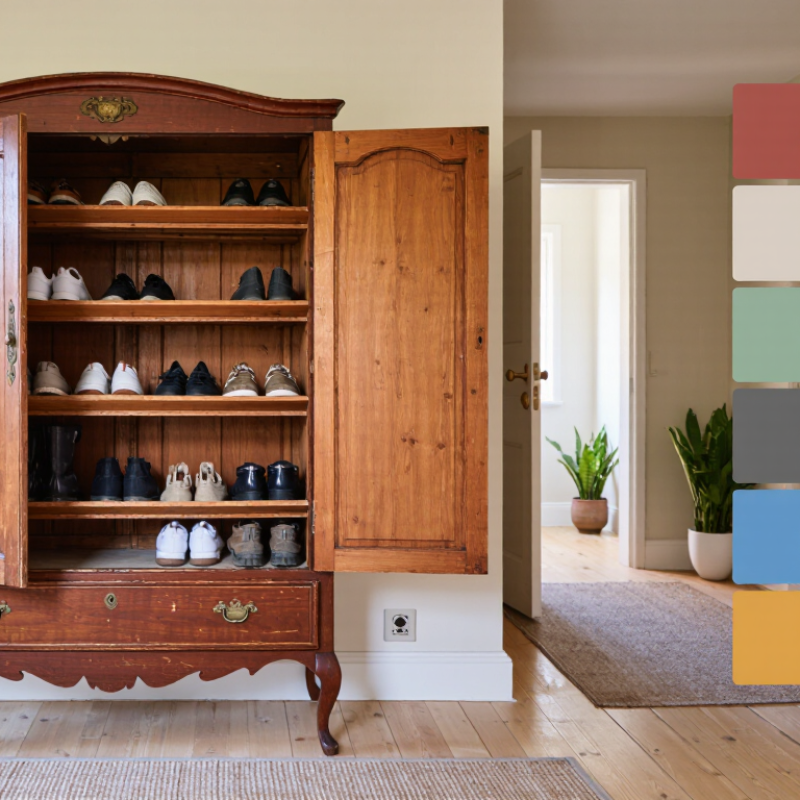
What Defines a Vintage Shoe Cabinet?
A vintage shoe cabinet is more than a new cabinet with an aged finish. In interiors, “vintage” commonly describes a piece around 20 years old or older, though sellers may use the term differently. Look for signs of genuine age: softened edges, small variations in the wood grain, and hardware that shows honest wear. These details should feel consistent, not artificially distressed. Age alone proves little.
Its purpose still matters. A useful cabinet has shelves deep enough for everyday shoes, doors that open without scraping, and some airflow to limit trapped odors. Check the back panel, hinges, and feet; a slight wobble can become a daily annoyance. Measure your entryway and your largest shoes before buying. The fit is easy to overlook. The U.S. Environmental Protection Agency’s 2018 Advancing Sustainable Materials Management report estimated that Americans generated 12.1 million tons of furniture and furnishings waste that year. That figure covers furniture broadly, not shoe cabinets specifically, but it gives reuse practical context. Choosing a sound older piece can keep usable material in service, though restoration may take more effort than expected.
How Vintage Shoe Cabinets Combine Storage and Design
Why Choose a Vintage Shoe Cabinet for Your Home?
How Vintage Shoe Cabinets Combine Storage and Design
A vintage shoe cabinet can make an entryway feel considered, not crowded. Its shallow profile keeps shoes near the door while preserving walking space. Look for ventilated doors, sturdy shelves, and a top surface for keys or a small lamp. Worn wood, aged brass pulls, and softened edges add texture that new furniture can struggle to imitate. Yet vintage does not always mean functional. Check shelf height and cabinet depth against the shoes your household actually wears.
Design also shapes how a room is experienced. In its 2023 Profile of Home Staging, the National Association of Realtors reported a useful signal. 81% of buyers’ agents said staging helped buyers visualize a property as their future home. This finding is not specific to shoe cabinets, but it supports a practical point: visible order can help an entry feel welcoming. Choose a restrained finish that anchors the space without making storage the main attraction. Measure the door swing, too. A beautiful cabinet that blocks the hallway is still a poor fit.
Tips: Outline the cabinet’s footprint on the floor and test the walkway before buying. Check for musty odors, loose joints, and uneven shelves. Leave room for air circulation, especially after rainy days. Sometimes the right piece needs a small repair. That is part of the charm—and part of the work.
Why Choose a Vintage Shoe Cabinet?
Vintage-inspired cabinets can pair practical shoe storage with a warm, furniture-like look. This chart shows how adding a usable shelf can increase estimated capacity.
How to read this: Estimates assume a 100 cm-wide cabinet and 25 cm of shelf width per pair, or four pairs per shelf. Actual capacity varies with shoe size, shelf depth, and cabinet design.
Materials, Styles, and Features to Consider
A vintage shoe cabinet can add character while solving a daily entryway problem. Look for solid wood, veneer, or metal, and inspect the cabinet’s back, hinges, and drawer bottoms. Solid wood is repairable, but it may be heavy; veneer can look refined, though chipped edges are harder to disguise. Check the joints. A little wobble matters.
Choose a style that suits the room, not just the photograph. A narrow cabinet with slatted doors can feel lighter in a tight hall, while a deeper piece may hold boots more easily. Measure your shoes and doorway before buying. Also check for ventilation and smooth-opening doors. A worn finish can be charming, but not every scratch deserves a romantic story. The U.S. Environmental Protection Agency’s Advancing Sustainable Materials Management report estimated that furniture and furnishings generated 12.1 million tons of waste in 2018, with 80.1% sent to landfills. Reusing a sturdy cabinet can extend its useful life, though condition still matters.
Tips: Measure the space, then test the doors and shelves. A quick sniff inside can reveal trapped dampness. Add felt pads under the feet to protect wood floors.
How to Match a Vintage Shoe Cabinet to Your Home
Why Choose a Vintage Shoe Cabinet for Your Home?
How to Match a Vintage Shoe Cabinet to Your Home
Start with the space, not the style. Measure the wall, doorway, and walking clearance before choosing a cabinet; older pieces can be deeper than they look. Measure the doorway first. In a narrow hall, a slim cabinet with lift-down compartments keeps shoes tucked away without crowding the path. For a wider entry, a low wooden cabinet can double as a landing spot for keys or a small lamp.
Match undertones rather than chasing an exact furniture set. Warm oak often sits comfortably beside cream walls, woven baskets, and aged brass; darker walnut can anchor pale floors and muted paint. Check the cabinet in your home’s daylight, since varnish can look much more orange near a window. I would not force a perfect match. A little contrast often feels more natural, though too many competing finishes can make a small entry look unsettled.
Budget and durability matter, too. The 2024 U.S. Houzz & Home Study reported a median renovation spend of $24,000 in 2023, up from $22,000 in 2022. That figure covers renovation projects, not shoe cabinets, but it offers useful context: a movable vintage piece may refresh an entry without changing fixed finishes. Inspect hinges, odors, and the cabinet base before buying. A scuffed surface can add character; a musty interior is harder to overlook.


 Distributors
 SDS Download
 Contact
