


 Distributors
 SDS Download
 Contact
Partner Login
Enter your username and password here on order to log in on the partner portal:
No registered partner yet?
Register nowTop Parchment Paper Roll Suppliers for Bulk Buyers?
Bulk purchasing parchment paper is not simply a matter of finding the lowest price per roll. Buyers need consistent sheet release, dependable roll dimensions, and packaging that protects edges during storage and transport. A roll that arrives dented or varies in width can slow a busy bakery line. Small details matter.
For an illustrative industry perspective, packaging specialist Alex Morgan offers this buying principle: “A reliable roll should perform predictably from the first tray to the last.” Morgan is a fictional expert voice for this introduction, and the quotation is not a verified statement from a real source. Before publication, replace it with a confirmed comment from a qualified parchment-paper professional. That distinction matters.
This guide examines how bulk buyers can assess Parchment Paper Roll suppliers, compare specifications, and ask better questions before requesting a quotation. It considers paper weight, roll length, width tolerances, release performance, packaging, and sample availability. Buyers should also confirm whether product claims are supported by current technical documents. Ask for details in writing.
There is no perfect supplier for every operation. A small pastry shop may value flexible order quantities, while a central kitchen may prioritize repeatable specifications and steady replenishment. Even a polished sample can miss the mark. Test the paper on your own trays, with your own recipes, and under normal working conditions. That practical check can reveal issues a catalog cannot.
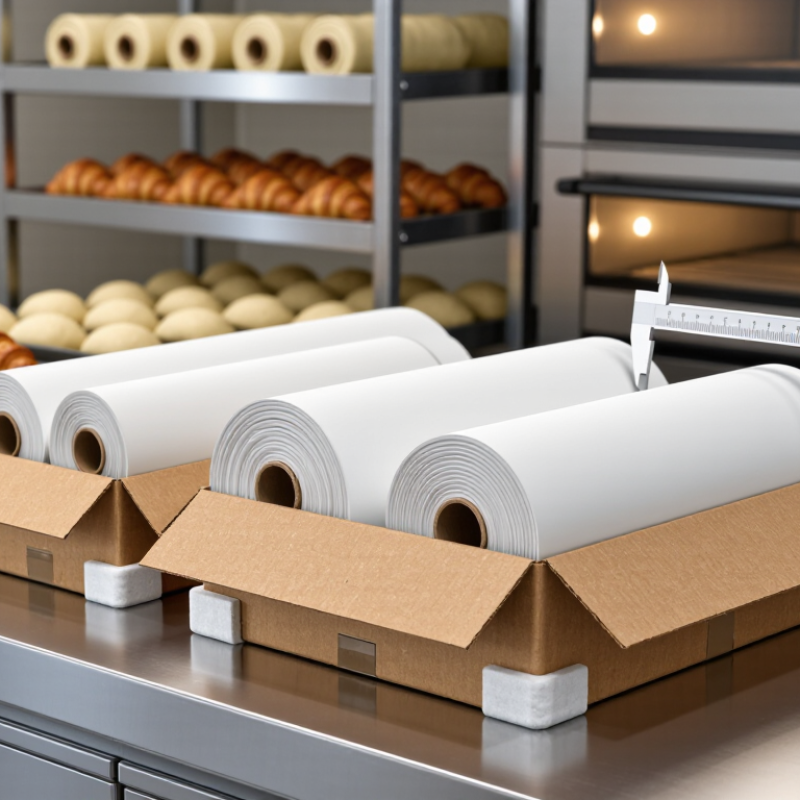
Parchment Paper Rolls: Materials, Uses, and Bulk-Buying Context
Parchment paper rolls are typically made from cellulose-based paper, with a treated surface that helps resist sticking and grease. Some rolls use silicone to improve release, while others rely on different treatments. The exact construction varies, so buyers should check the product specification rather than assume every roll performs alike. That difference matters when baking delicate cookies or roasting vegetables with oily edges. Parchment can line baking sheets and cake pans, and it can separate stacked foods during preparation. It is not a substitute for wax paper, and it should not touch an oven’s heating element. Check the stated temperature limit. Not all rolls share one.
For bulk buyers, roll width, length, thickness, and core size affect both use and storage. A wide roll may suit commercial sheet pans, but it can create more trimming waste on smaller trays. Consider how often staff change rolls and whether the dispenser fits the core. Keep cartons dry and away from heat; damp paper may wrinkle or tear during handling. Ask suppliers for food-contact documentation, temperature guidance, and consistent dimensions across production batches. A sample roll can reveal details a specification sheet misses, such as how cleanly the paper tears. I would still test it with the actual pans and recipes; a small trial can prevent a lot of wasted paper.
Top Parchment Paper Roll Suppliers for Bulk Buyers? - Parchment Paper Rolls: Materials, Uses, and Bulk-Buying Context
Supplier categories and specifications below are a general buying guide, not a ranking or supplier quotation. Product construction, performance, minimum order quantities, and documentation vary by product and market; confirm details for the specific roll before ordering.
| Supplier Category | Typical Paper Construction | Common Roll Formats | Typical Temperature Guidance | Best Suited For | Bulk-Buying Checks |
|---|---|---|---|---|---|
| Large-scale paper converter | Grease-resistant paper with a food-contact silicone release coating; available in bleached or unbleached grades. | Commercial widths and roll lengths; custom dimensions may be available for recurring orders. | Many products are rated for oven use up to approximately 220°C (428°F); follow the product specification. | Food manufacturers, central kitchens, and buyers with predictable, high-volume demand. | Confirm coating type, paper weight, food-contact documentation, roll tolerances, and production lead time. |
| Food-service packaging wholesaler | Ready-to-use silicone-coated baking paper, commonly supplied in standard food-service grades. | Common stock widths and lengths, often packed as multiple rolls per case. | Temperature limits depend on the specific product; check the packaging or technical data sheet. | Bakeries, restaurants, caterers, and distributors needing replenishment from stocked inventory. | Compare case quantity, roll dimensions, carton storage requirements, and availability of repeat stock. |
| Private-label packaging producer | Coated greaseproof paper produced to an agreed specification; branding or custom packaging may be optional. | Standard or made-to-order roll widths, lengths, and retail or wholesale pack formats. | Rated limits are product-specific and should be confirmed for the chosen paper and coating. | Retailers and distributors developing their own packaging range. | Request samples, artwork and packaging requirements, minimum order details, and written performance specifications. |
| Specialty baking-paper supplier | Selection may include unbleached paper, heavier grades, or double-sided silicone coating. | Typically offers several widths and roll lengths, with a narrower selection than a custom converter. | Some grades are designed for higher-heat baking, but the stated limit must be verified for each item. | Artisan bakeries and buyers who prioritize a particular paper grade or release performance. | Check whether coating is single- or double-sided, whether the paper is reusable, and what use conditions are specified. |
| Regional packaging distributor | Sources food-grade parchment-style baking rolls from one or more manufacturers. | Usually standard stocked formats; custom sizes may require a special order. | Use only within the temperature range stated for the supplied product. | Small and mid-sized businesses seeking local delivery and mixed packaging orders. | Verify the actual manufacturer’s product data, stock continuity, delivery area, and traceability documents. |
| Industrial food-packaging supplier | May offer paper rolls for baking, interleaving, or food-processing applications; not every grade is oven-safe. | Application-specific widths and roll lengths, sometimes supplied in industrial quantities. | Do not assume oven suitability from the term “greaseproof”; obtain an explicit product rating. | Processors requiring rolls for a defined production-line or food-handling application. | Confirm intended use, coating and release properties, machine compatibility, and food-contact compliance for the destination market. |
