What Are the China Top 10 UAV Camera Gimbal Manufacturers?
The rapid expansion of commercial drones has increased demand for precise, stable, and lightweight imaging systems. A Uav Camera Gimbal now supports aerial inspection, mapping, public safety, agriculture, cinematography, and infrastructure monitoring. It is more than a rotating mount. It combines motors, sensors, vibration control, image transmission, and software calibration inside a compact platform.
Industry reports indicate strong long-term momentum. Fortune Business Insights valued the global drone market at approximately USD 30.6 billion in 2022 and expects substantial growth through 2030. MarketsandMarkets also forecasts continued expansion in commercial drone applications, especially inspection, surveying, and security. Grand View Research’s drone camera studies highlight rising demand for high-resolution imaging and stabilized payloads. These figures matter, but definitions vary. Some reports include complete drone systems, while others measure cameras or services separately.
China has become a major manufacturing center for these technologies. Its suppliers often combine precision machining, brushless motors, flight-control integration, and large-scale electronics production. However, ranking the China top 10 UAV camera gimbal manufacturers requires more than checking export volume or online visibility. Product reliability, stabilization accuracy, payload compatibility, after-sales support, certifications, and field experience deserve equal attention.
The comparison ahead evaluates leading Chinese manufacturers through these practical criteria. Laboratory specifications can look impressive. Real flights reveal more. Wind, vibration, temperature changes, and imperfect calibration often expose weaknesses. Some available market data is incomplete, and supplier claims may require independent verification. This article therefore offers a careful industry overview, not an absolute verdict.
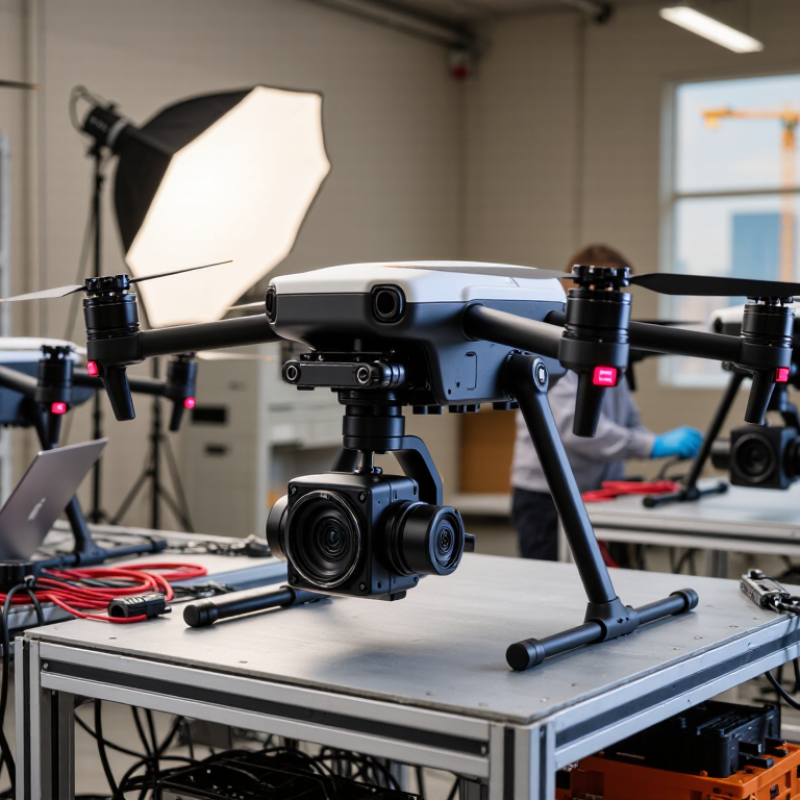
What Defines a UAV Camera Gimbal Manufacturer?
What defines a UAV camera gimbal manufacturer is not a polished housing or a low quotation. It is repeatable engineering. A capable manufacturer designs the motor, controller, camera interface, firmware, and mounting structure as one system. Field experience matters here. A gimbal must hold a stable horizon while propeller vibration, wind, and sudden yaw changes disturb the aircraft.
Industry data shows why this discipline matters. Fortune Business Insights valued the global drone market at about US$30.6 billion in 2023 and projected strong growth through 2030. Drone Industry Insights also identifies inspection, mapping, and public-safety operations as major commercial applications. These missions demand more than basic stabilization. Buyers should examine angular accuracy, response latency, payload limits, operating temperature, and vibration-test results. Published test methods are more convincing than attractive product videos.
A serious Chinese manufacturer should provide calibration records, traceable quality controls, and documented production capacity. ISO 9001 certification can support confidence, but it does not replace independent testing. Look for thermal cycling, ingress protection, electromagnetic compatibility, and long-duration flight trials. MarketsandMarkets reports continuing expansion in the UAV sector, increasing pressure on suppliers to deliver consistent systems, not isolated prototypes. Some manufacturers still emphasize specifications while overlooking repair access and software updates. That weakness is easy to discover in the field. Ask for sample data, failure-rate evidence, and clear warranty procedures before comparing the top ten. (Sources: Fortune Business Insights, Drone Industry Insights, MarketsandMarkets, 2024.)
What Defines a UAV Camera Gimbal Manufacturer?
Evaluation dimensions used when comparing professional UAV camera gimbal manufacturers
How to read the chart: The weighting model reflects measurable factors commonly used in UAV payload procurement. Stabilization performance and sensor integration are prioritized because they directly affect image quality, flight data reliability, and mission results. Environmental protection, software integration, production consistency, and technical support determine whether a manufacturer can deliver dependable systems at scale.
How China’s Top 10 UAV Gimbal Manufacturers Are Selected
When assessing China’s top 10 UAV camera gimbal manufacturers, we begin with evidence, not advertising claims. Our review team examines factory capabilities, engineering records, and published test data. We request samples or arrange technical demonstrations when practical. A gimbal must hold a steady horizon during vibration, wind changes, and rapid yaw movements. Small details matter: motor response, bearing smoothness, cable strain relief, and heat control.
Selection also considers image quality, payload compatibility, and software integration. Production consistency is also reviewed. We compare stabilization performance across daylight, low-light, and moving-scene tests. Engineers review control interfaces, calibration procedures, operating temperatures, and maintenance access. Clear technical documents strengthen a manufacturer’s credibility. Independent quality certifications and traceable inspection records provide further confidence. After-sales support is important too. Response time can decide whether a field issue lasts hours or several days.
We score each manufacturer against the same practical criteria. Price alone does not determine placement. A low-cost unit may perform well, but limited documentation creates uncertainty. Public information is sometimes incomplete, and that affects our confidence. We may revise a ranking after longer service trials or new test results. This approach is not perfect. It still offers a more dependable comparison for buyers seeking stable aerial imaging equipment.
Profiles of China’s Top 10 UAV Camera Gimbal Manufacturers
China’s top 10 UAV camera gimbal manufacturers serve different aerial imaging needs. Their profiles reveal varied strengths rather than one universal leader. A practical review should examine stabilization, sensor compatibility, control software, production quality, and after-sales support.
One manufacturer specializes in lightweight gimbals for compact drones. Another focuses on three-axis stabilization for mapping missions. A third develops thermal imaging mounts for lawful industrial inspection. The fourth builds dual-sensor systems for day and night surveys. The fifth supports custom mechanical designs and short development cycles. A sixth emphasizes vibration isolation for aircraft operating in strong wind. The seventh produces long-range optical payloads for infrastructure monitoring. The eighth integrates image transmission and remote control interfaces. The ninth targets agricultural surveys with multispectral camera support. The tenth provides larger platforms for demanding public-service and commercial applications.
Field experience shows that smooth footage depends on more than motor torque. Cable routing, balance calibration, firmware tuning, and temperature control matter greatly. Ask for laboratory test data and real flight samples. Specifications can look impressive on paper. They may not reflect performance after repeated landings or dusty operations. Some suppliers offer strong engineering but limited documentation. Others communicate clearly but need longer customization periods. That trade-off deserves careful review. Buyers should also verify compliance, repair procedures, spare-part availability, and data-handling practices before purchase. No manufacturer is perfect, and even a well-designed gimbal may need retuning after installation.
How to Choose the Right Chinese UAV Gimbal Manufacturer
Choosing a Chinese UAV gimbal manufacturer requires more than scanning a “top 10” list. Rankings may reflect visibility, not engineering suitability. Start with your aircraft, payload, flight time, and operating environment. A compact mapping drone needs different stabilization from a heavy platform used for inspection.
Ask each manufacturer for measured data. Check angular accuracy, vibration performance, image latency, payload weight, and operating temperature.
Request raw test footage, not only edited demonstrations. Review the camera sensor, lens options, communication protocols, and mounting dimensions. Small mismatches can create expensive redesigns.
Audit production quality carefully. Confirm calibration procedures, incoming component checks, and final inspection records. Quality certifications can help, but they do not replace product testing. Ask about sample approval, spare parts, firmware updates, and remote troubleshooting. A reliable supplier should explain failure handling clearly. Vague answers deserve attention.
Run a pilot order before committing to volume. Test the gimbal during takeoff, sudden movement, wind exposure, and repeated power cycles. Measure results with your own flight controller and software.
In my view, this step is often underestimated.
A polished sample may perform differently in real integration. Also verify export documents, warranty terms, lead times, and communication responsibilities. The cheapest quotation may become costly after delays, unstable firmware, or limited technical support.


 Distributors
 SDS Download
 Contact
