
X

Partner Login

Enter your username and password here on order to log in on the partner portal:

No registered partner yet?

Register now

Top 10 Types of Box Design Ex Motors for Global Buyers

Choosing an explosion-protected motor is rarely a simple catalog decision. Global buyers must match the motor with hazardous-area classification, voltage, frequency, load, enclosure rating, and installation conditions. This guide introduces the Top 10 Types of Box Design Ex Motors for Global Buyers, focusing on practical differences rather than attractive specifications alone.

Box Design Ex Motors are often selected for their enclosed construction, compact appearance, and suitability for demanding industrial environments. They may support pumps, conveyors, compressors, fans, mixers, and processing equipment. A motor used near chemical vapors needs different protection from one installed where combustible dust accumulates. Temperature class matters too. So does cooling.

Look closely.

Experienced procurement teams compare rated power, starting current, duty cycle, ambient temperature, mounting position, and maintenance access. They also request valid certification documents and confirm whether the product suits the destination market. Certification names can differ between regions, so assumptions create risk. An apparently suitable motor may still fail because its cable entry, shaft size, or terminal box arrangement does not match the equipment.

This overview uses engineering practice, manufacturer data, and common purchasing concerns to explain ten important motor types. It aims to help buyers ask better questions before requesting quotations. Still, no shortlist is flawless. Real installations contain humidity, vibration, dust, heat, and imperfect maintenance. That reality should shape the final selection. Always verify the complete specification with a qualified engineer and the authorized manufacturer before approval.
Top 10 Types of Box Design Ex Motors for Global Buyers

IEC 60079 and IEC 60034-1: The Classification Framework for Ex Motors

For global buyers, “Ex motor” is not a single product category. It is a compliance decision shaped by the hazardous location, gas or dust, and operating duty. IEC 60079 provides the core framework for equipment used in explosive atmospheres. It addresses protection concepts, equipment groups, zones, temperature classes, construction, testing, and marking. A flameproof enclosure, increased-safety motor, pressurized motor, or dust-protected motor follows different design logic. The box shape alone proves little.

IEC 60034-1 works beside it, not instead of it. This standard defines general motor ratings and performance, including power, voltage, frequency, duty, temperature rise, and performance tolerances. It helps buyers compare a 50 Hz motor with a 60 Hz application. It does not, by itself, authorize use in a hazardous area. A motor may satisfy IEC 60034-1 and still be unsuitable for Zone 1 or combustible dust. This distinction is often missed.

In a real purchase, match the motor marking with the site classification and required protection method. Check gas or dust group, temperature class, ambient temperature, ingress protection, cable entries, and maintenance limits. Review the certificate and technical schedule, not only the catalogue headline. Different IEC 60079 parts address gas, dust, inspection, repair, and installation. The framework looks clean on paper; field conditions are not. I would question any selection made from enclosure appearance alone. A small mismatch in temperature or dust protection can invalidate an otherwise strong motor choice.

Flameproof Ex d Motors: Zone 1/2 Protection and Gas Groups IIA–IIC

Top 10 Types of Box Design Ex Motors for Global Buyers

Flameproof Ex d motors protect ignition-sensitive workplaces through a strong, jointed enclosure. Internal pressure may occur after gas ignition. The enclosure contains the flame and cools escaping gases. For Zone 1, the motor may face explosive gas during normal operation. Zone 2 usually means gas appears only during abnormal conditions. The difference affects certification, maintenance, and purchasing decisions.

The gas group matters. IIA covers less demanding gases, while IIB and IIC require tighter flame paths. IIC is the most demanding group in this range. The motor must also match the required temperature class. A T4 motor, for example, limits surface temperature to 135°C. IEC 60079-0 and IEC 60079-1 provide the technical foundation for equipment selection. The IEA Global Methane Tracker 2024 estimated over 120 million tonnes of methane emissions from fossil fuel operations in 2023. This reinforces the need for disciplined equipment selection around gas-handling systems. Still, certification alone is not enough.

Tips: Confirm the exact zone, gas group, T-class, IP rating, ambient temperature, and cable-entry system. Check the complete motor assembly, not only the enclosure label. Experienced inspectors often find mismatched glands or missing temperature data. That mistake is surprisingly common. Buyers should request certificates, routine-test records, and maintenance instructions. One practical concern remains: local installation rules may add requirements beyond IEC certification. Treat the datasheet as a starting point, not final proof.

Top 10 Types of Box Design Ex Motors for Global Buyers - Flameproof Ex d Motors: Zone 1/2 Protection and Gas Groups IIA–IIC

Typical flameproof terminal-box configurations for hazardous-area motor applications

Selection data are typical industry configurations. Actual Zone, gas-group, temperature-class, cable-entry and power limits must be confirmed against the motor certificate and installation requirements.
No. Box Design Type Terminal-Box Arrangement Typical Mounting / Entry Typical Hazardous Zone Gas Group Common Temperature Class Typical Power Range Recommended Application
1 Standard Top-Mounted Flameproof Box One main Ex d terminal chamber with bolted cover Top entry; cable glands selected for the cable type and certification Zone 1 / Zone 2 IIA, IIB; IIC when specifically certified T4; T3 or T5/T6 subject to design and certification Approximately 0.12–315 kW General-purpose process equipment and fixed industrial drives
2 Side-Mounted Flameproof Box Ex d chamber positioned on the motor side for improved access Left- or right-side mounting; horizontal cable entry Zone 1 / Zone 2 IIA / IIB; IIC only with applicable certification T4 commonly specified Approximately 0.75–250 kW Skid-mounted pumps, compressors and equipment with limited top clearance
3 Rotatable Terminal-Box Design Terminal box designed for approved 90° position changes Flexible cable direction; rotation must preserve certified joints and sealing Zone 1 / Zone 2 IIA, IIB or IIC according to certificate T4 typical; other classes are application-dependent Approximately 1.1–200 kW Retrofit projects and installations where cable routing varies by site
4 Two-Compartment Flameproof Box Separate power-terminal and auxiliary-terminal chambers Independent entries for power, sensors and control wiring Zone 1 / Zone 2 IIA / IIB; IIC available only in certified versions T4 commonly used Approximately 7.5–315 kW Motors requiring separate instrumentation, anti-condensation heaters or RTDs
5 Large-Cable / High-Current Box Deep Ex d chamber with enlarged terminals and increased creepage distance Large metric or NPT entries; gland size depends on cable diameter Zone 1 / Zone 2 IIA / IIB; IIC subject to tested enclosure configuration T3 or T4 depending on motor loading Approximately 90–1,000 kW Large pumps, fans, compressors and high-inertia machinery
6 IIC-Optimized Compact Box Compact Ex d enclosure using certified narrow flame paths and terminal spacing Compact side or top entry; only approved glands and plugs may be used Zone 1 / Zone 2 IIC T4; T3 or T6 where specifically certified Approximately 0.12–90 kW Hydrogen, acetylene or other high-risk gas-group applications within certificate scope
7 Instrumented Flameproof Box Power terminals plus dedicated terminals for RTDs, thermistors and heaters Multiple sealed entries with segregated low-voltage wiring Zone 1 / Zone 2 IIA / IIB; IIC if the complete assembly is certified T4 typical Approximately 5.5–500 kW Continuous-process plants requiring condition monitoring and thermal protection
8 Vertical-Shaft Motor Box Flameproof box positioned for vertical motor installation and service access Top, side or remote entry depending on vertical layout Zone 1 / Zone 2 IIA / IIB; IIC by certified design T4 commonly specified Approximately 1.5–250 kW Vertical pumps, agitators and cooling-tower equipment
9 Remote-Terminal / Extended-Box Design Terminal enclosure offset from the main frame by a certified extension Used where direct access is obstructed; extension length is design-specific Zone 1 / Zone 2 IIA / IIB; IIC only when covered by certification T4 typical Approximately 15–500 kW Motors installed behind guards, in congested skids or near hot equipment
10 Split-Entry Flameproof Box Multiple certified entry plates for separate power and auxiliary cable routes Opposite-side or multi-directional entries; unused openings require certified stopping plugs Zone 1 / Zone 2 IIA, IIB or IIC according to the approved entry system T4 typical; final class depends on motor surface temperature Approximately 11–315 kW Complex installations with separate VFD, control, heater and instrumentation cables

Increased-Safety Ex e Motors: EPL Gb/Gc and Temperature Classes T1–T6

Top 10 Types of Box Design Ex Motors for Global Buyers

Increased-Safety Ex e motors require careful reading of EPL and temperature markings. Ex eb Gb equipment suits Zone 1 areas with a high protection level. Ex ec Gc equipment generally suits Zone 2 areas with reduced ignition risk. These ratings are defined through the IEC 60079 series, not marketing language. Temperature classes limit the maximum surface temperature: T1 reaches 450°C, while T6 remains below 85°C. A hotter motor can ignite surrounding gas, even when the enclosure appears secure.

Temperature classes limit the maximum surface temperature: T1 reaches 450°C, while T6 remains below 85°C.

Motor choice also affects operating cost. The U.S. Department of Energy’s Motor System Market Assessment identifies motor-driven systems as a major share of industrial electricity use. Therefore, buyers should examine efficiency, starting current, cooling, and ambient temperature together. A T4 motor may not suit every process. Dust buildup, blocked airflow, or frequent starts can raise its actual surface temperature. One practical lesson is uncomfortable: certification alone does not guarantee correct installation. Selection errors still happen.

Tips: Check the complete marking, such as Ex eb IIC T4 Gb or Ex ec IIC T5 Gc. Confirm the hazardous-zone classification, gas group, ambient range, cable entries, and thermal protection. Request test documentation aligned with IEC 60079-0 and IEC 60079-7. Also review IECEx conformity records and the latest project risk assessment. Small details matter.

Dust-Protected Ex t Motors: Zones 21/22, IP Ratings, and Dust Groups

Top 10 Types of Box Design Ex Motors for Global Buyers: Dust-Protected Ex t Motors

Dust-protected Ex t motors use an enclosure to limit dust entry and surface temperatures. In hazardous dust areas, Zone 21 means combustible dust clouds may occur during normal operation. Zone 22 covers dust clouds that appear only occasionally or briefly. IEC 60079-31:2022 links Ex t protection with enclosure design, temperature limits, and dust-group classification. The motor should match the site’s assessed hazard, not merely its catalog description.

IP ratings provide a practical inspection point. Under IEC 60529, IP5X is dust-protected, while IP6X is dust-tight. For conductive dust in Group IIIC, designers commonly require IP6X and tighter joint control. Groups IIIA, IIIB, and IIIC cover combustible flyings, non-conductive dust, and conductive dust. Small gaps matter. Cable glands, terminal boxes, cooling ribs, and shaft seals can become weak points.

A 2023 technical review from the International Society of Automation highlights enclosure integrity and maintenance as recurring factors in hazardous-area reliability. That finding matches field experience: a clean motor can still fail after a damaged gasket or loose cable entry. Check the certificate, EPL marking, ambient range, and temperature class together. One overlooked detail can change the installation decision. I would not rely on IP numbers alone. Site dust behavior, cleaning methods, and accumulated layers still require competent assessment.

Top 10 Types of Box Design Ex Motors for Global Buyers

Dust-Protected Ex t Motors: Zones 21/22, IP Ratings, and Dust Groups

This comparison shows representative Ex t motor enclosure configurations and their typical IP characteristics. The first IP digit indicates protection against solid particles, while the second digit indicates protection against water. IP6X is dust-tight; the final certification must confirm suitability for the required zone, dust group, EPL, and maximum surface temperature.

Zone 21 generally requires EPL Db, while Zone 22 generally requires EPL Dc. Dust groups include IIIA for combustible flyings, IIIB for non-conductive dust, and IIIC for conductive dust. Selection should be verified against IEC 60079-31 and IEC 60529.

IE3–IE5 Efficiency, 50/60 Hz Ratings, and Global Motor Selection Criteria

Top 10 Types of Box Design Ex Motors for Global Buyers

Box design Ex motors suit hazardous industrial areas where dust, gas, moisture, or heat can create serious risks.

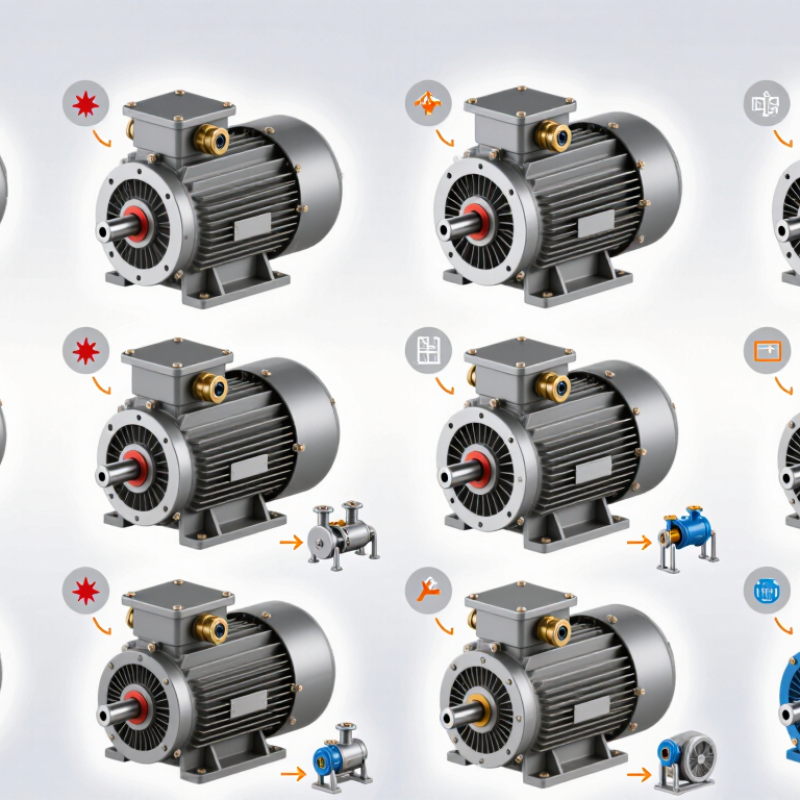
Common options include flameproof, increased-safety, non-sparking, dust-protected, pressurized, encapsulated, brake, geared, vertical, and water-cooled configurations. Each design serves different operating conditions. Protection markings must match the site classification, not just the motor nameplate.

IE3 motors often balance purchase cost and dependable energy savings. IE4 and IE5 motors can reduce losses during long operating hours, especially under stable loads. However, higher efficiency does not always mean better value. A lightly loaded motor may provide limited savings.

Check rated power, actual load, duty cycle, starting method, ambient temperature, altitude, and cooling conditions. Frequency matters too. A 50 Hz motor may run differently at 60 Hz, affecting speed, torque, current, and temperature. Voltage compatibility must be verified separately.

Tips: Request complete certificates, efficiency test data, temperature-class details, and zone approvals. Confirm gas or dust group requirements with a qualified engineer. Small errors matter. I would also compare lifetime energy cost, not only the purchase price. A perfect selection is rarely possible, because site data may be incomplete or changing. Keep spare-part availability and local service capability in the evaluation.