Top 10 RF Divider Manufacturers in China for Global Buyers
An Rf Divider looks modest on a network diagram: a small metal body, coaxial ports, and a specified split ratio. Its performance is anything but small. In a cellular base station, satellite terminal, or test bench, insertion loss, isolation, phase balance, and power handling can affect the whole signal path. Buyers comparing Chinese manufacturers should examine measured specifications, frequency coverage, connector options, and calibration practices—not just the lowest quoted price.
The broader demand is clear, though it is not a divider-market forecast. GSMA’s The Mobile Economy 2024 estimated that mobile technologies and services generated 5.4% of global GDP in 2023, equivalent to US$5.7 trillion. Yole Group’s RF front-end market studies offer further context on the components supporting wireless systems. These reports do not isolate RF Divider sales, so their figures should not be presented as direct evidence of divider-market size. Details matter.
A useful supplier review starts with the test report. Check the frequency range, amplitude and phase balance, isolation, return loss, and operating temperature. Ask whether the published data reflect the exact model being quoted. A polished datasheet is not a production audit. No source material was provided for a verifiable quotation from an RF Divider specialist, so none is attributed here. That restraint matters: a fabricated expert quote would weaken buyer confidence. The manufacturers below are best assessed through traceable specifications, sample testing, and clear engineering support.
RF Dividers: Definition, Types, and Core Applications
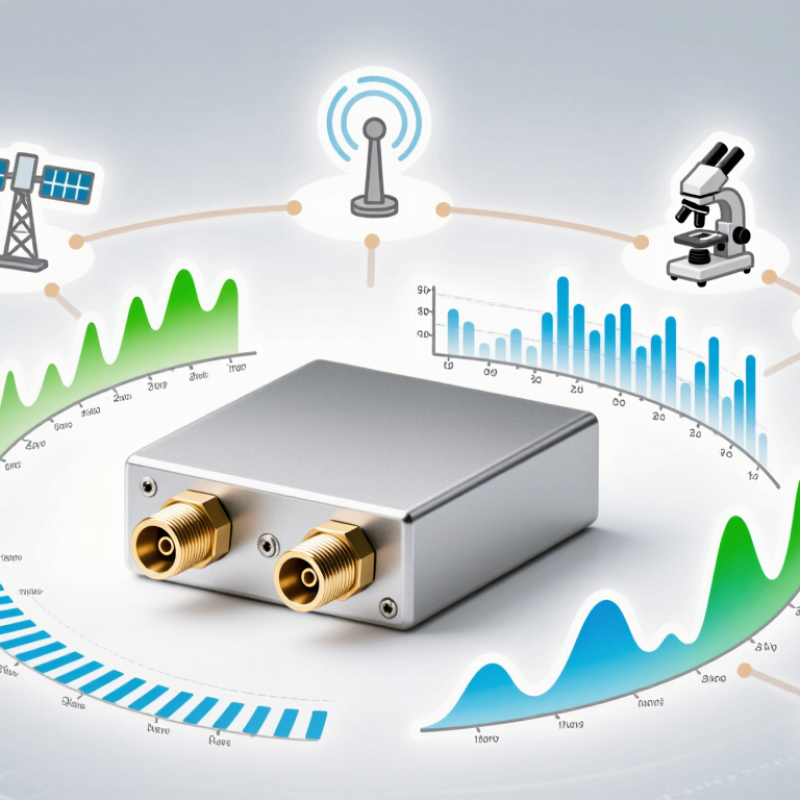
An RF divider splits one radio-frequency signal into two or more output paths while controlling how power is distributed. It is used in systems where multiple antennas, receiver channels, or test instruments need a shared signal. A two-way divider ideally delivers half the input power to each output, though real components have insertion loss. Small details matter. Frequency range, connector type, impedance, isolation, and power rating all affect performance.
Common designs include resistive dividers and Wilkinson dividers. Resistive models are compact and broadband, but typically lose more power and may offer less isolation. Wilkinson designs use transmission lines and resistive elements to provide better port isolation across a specified band. Unequal split ratios are available too. The trade-off is easy to overlook: a divider’s stated bandwidth does not guarantee equally strong performance at every frequency.
RF dividers appear in wireless infrastructure, radar equipment, satellite links, and laboratory measurement setups. For example, an engineer might split a signal from a generator to compare two receiver paths on a bench. In field equipment, size and temperature range can matter as much as insertion loss. Datasheets help narrow choices, but real layouts, cables, and connectors can change measured results. Testing the assembled system remains worthwhile.
How RF Dividers Work and Which Specifications Matter
An RF divider splits one input signal into multiple outputs. A two-way equal split gives each port half the input power, or an ideal 3.01 dB loss. Real devices add excess loss. Wilkinson designs use resistors to improve output-to-output isolation, while simple resistive dividers trade lower cost for greater loss. On a bench, a small mismatch can show up as uneven output levels or a shifted phase.
Check the operating frequency range first, then compare insertion loss, amplitude and phase balance, isolation, and input/output return loss. Also verify power handling, connector type, and temperature range. These figures matter in antenna arrays, where poor balance can weaken beam performance. ITU-R Report M.2410-0 sets IMT-2020 peak-rate targets of 20 Gbit/s downlink and 10 Gbit/s uplink. Those are system targets, not divider requirements, but they underline why predictable RF paths matter at high performance levels.
Tips: Compare data at your actual frequency, not just the catalog’s headline figure. Ask for test conditions and measurement uncertainty; a spec without them can be less useful than it looks. And honestly, connector details are easy to overlook until installation day.
RF Divider Basics: Ideal Split Loss by Output Count
For an ideal, equal-split RF divider, each output receives a fraction of the input power. The corresponding split loss is 10 × log₁₀(N) dB, where N is the number of outputs. Real devices also have excess insertion loss, mismatch, and frequency-dependent performance, so compare those specifications in datasheets.
How to Evaluate RF Divider Manufacturers in China
When evaluating RF divider manufacturers in China, start with the operating conditions your system actually requires. Compare frequency range, insertion loss, port isolation, return loss, and amplitude and phase balance. Check that specifications cover your intended bandwidth, not just one attractive test frequency. Small differences can matter in a multi-channel receiver.
Ask for a recent test report and confirm how measurements were taken. Was the divider tested with the stated connectors and impedance? What instruments and calibration method were used? Request data for several production units, not only a prototype. Consistency matters. A polished datasheet can still leave questions. Check power handling, operating temperature, housing dimensions, connector quality, and whether custom configurations affect lead time or performance. If possible, review a sample and inspect its labeling, finish, and ports before approving a larger order.
Communication is part of the evaluation, too. Send a clear requirement sheet and see whether the supplier identifies missing details, such as connector gender or phase tolerance. Ask how revisions and quality checks are documented. A low quote may exclude testing or packaging; clarify both. No single score tells the whole story. Some buyers focus heavily on price, then discover their test setup was never discussed. Compare evidence, response quality, and repeatability alongside cost.
Top 10 RF Divider Manufacturers in China for Global Buyers
Global buyers comparing China’s RF divider manufacturers should look beyond price and catalog frequency. Ericsson’s June 2024 Mobility Report projects 5.6 billion 5G subscriptions by 2029, increasing demand for dependable signal distribution in networks and test systems. That forecast does not measure divider sales directly. It does show why stable performance matters. Ask suppliers for measured insertion loss, isolation, amplitude balance, phase balance, and power handling across the full operating band.
Request a sample test report, not only a specification sheet. Check whether its frequency sweep matches your intended band, and confirm connector type, operating temperature, and production tolerances. Small differences can matter: a divider used on a crowded lab bench faces different conditions from one installed in a temperature-controlled cabinet. Look for documented calibration methods, batch traceability, and clear responses to engineering questions. Useful details.
The ITU’s Facts and Figures 2024 estimates that 5.5 billion people were online, about 68% of the global population. This wider connectivity trend gives buyers reason to assess suppliers’ capacity and quality controls, not just one sample’s results. A polished datasheet is not proof. Ask how units are screened between batches, and compare repeat measurements where possible. This takes time, and supplier documents may still leave gaps. That is worth noticing.
Sourcing, Quality Checks, and Export Considerations for Global Buyers
For a Chinese RF divider supplier, request a frequency-specific datasheet before comparing quotations. Check insertion loss, isolation, amplitude balance, phase balance, impedance, and power handling against your system needs. Ask for measured S-parameter plots, test conditions, and calibration dates; a headline specification alone proves little. WSTS reported global semiconductor sales of $627.6 billion in 2024, up 19.1% year over year. That growth signals a busy electronics supply chain, but it does not guarantee stable lead times for passive RF parts. Plan around confirmed production slots, not optimistic estimates.
Evaluate samples from the same production process proposed for your order. Inspect connector alignment, housing finish, labels, and packaging, then compare sample measurements with the production acceptance limits. Request lot traceability, inspection records, and a clear process for handling nonconforming units. The GSMA’s Mobile Economy 2025 report estimated that mobile technologies and services generated $6.5 trillion in economic value during 2024, supporting continued demand for network equipment. Still, a supplier’s capacity claim needs verification. I would ask for a written lead-time range, export packing details, commercial invoice data, country-of-origin information, and agreed delivery terms. Small omissions can delay receipt. Check them early. These details may feel routine, but buyers often discover gaps only after a shipment is booked.


 Distributors
 SDS Download
 Contact
