X

Partner Login

Enter your username and password here on order to log in on the partner portal:

No registered partner yet?

Register now

Top Turbo Intercooler Manufacturers Worldwide

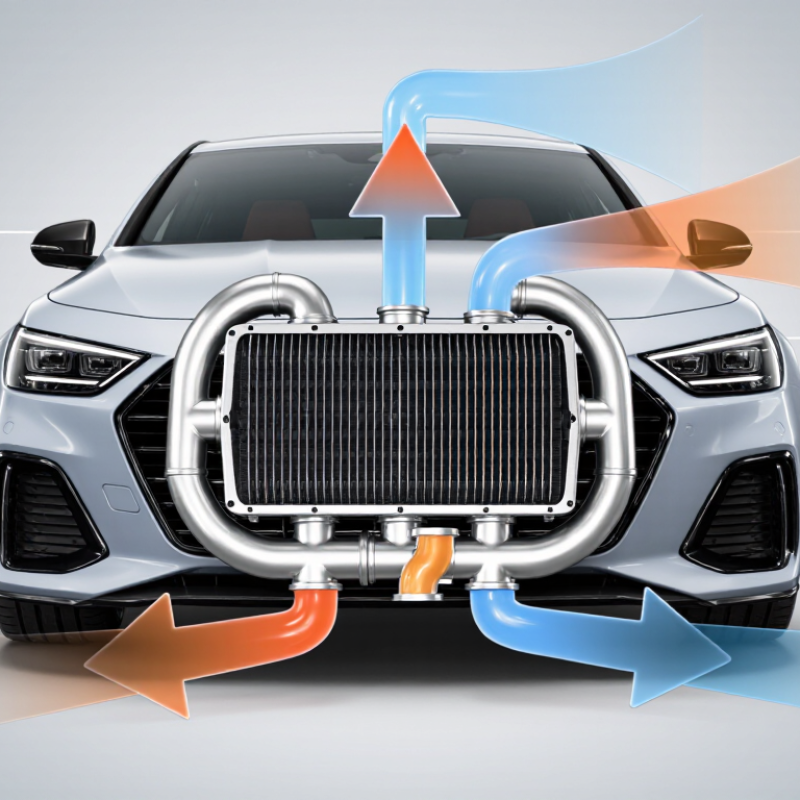
Choosing among the top Turbo Intercooler manufacturers worldwide requires more than comparing core size or advertised horsepower. A reliable intercooler must control charge-air temperature, preserve airflow, and survive vibration, pressure, moisture, and repeated heat cycles. It sits behind the grille, yet its work is intense. Hot compressed air leaves the turbocharger and enters the intercooler, where carefully designed fins and passages remove heat before combustion begins.

Corky Bell, a respected forced-induction author, explains, “An intercooler is a heat exchanger for compressed intake air.” That simple description carries practical weight. A larger unit is not automatically better. Excessive volume can increase pressure drop and delay boost response. Poor fin design can restrict airflow. Weak welds may fail when the engine repeatedly sees high boost. The details matter.

This guide examines leading Turbo Intercooler manufacturers through engineering quality, testing methods, material selection, production consistency, and real-world fitment. It considers bar-and-plate and tube-and-fin designs, end-tank structure, core efficiency, and thermal recovery after demanding use. Factory data is useful, but not perfect. Independent testing can reveal differences that marketing pages overlook. Even then, results depend on vehicle layout, ambient temperature, boost pressure, and calibration.

Some conclusions may remain debatable. That is acceptable. Honest comparison should leave room for revision. The strongest manufacturers combine measurable performance with dependable quality control, clear technical documentation, and support after installation. For buyers, the goal is not the largest intercooler. It is the right balance of cooling, response, durability, and verified engineering.
Top Turbo Intercooler Manufacturers Worldwide

Turbo Intercoolers: Purpose, Structure, and Operating Principles

Top Turbo Intercooler Manufacturers Worldwide

Turbo Intercoolers: Purpose, Structure, and Operating Principles

A turbocharger compresses air before it enters the engine. Compression raises air temperature and reduces oxygen density. The intercooler removes much of this heat. SAE International test literature commonly records charge-air reductions of 40–80°C under heavy boost. Cooler air supports more stable combustion and helps control knock risk.

Most intercoolers use an aluminium core, internal passages, external fins, inlet tanks, and outlet tanks. Air-to-air designs transfer heat through ambient airflow. Air-to-liquid designs use a coolant circuit and usually respond faster during short acceleration events. The operating principle is simple: hot compressed air crosses thin walls, while a cooler medium carries heat away. The design still involves trade-offs. Larger cores improve cooling, but excessive volume can increase pressure drop and response delay. Real-world results are less tidy.

Tips: Check temperature before changing hardware. The U.S. Department of Energy’s vehicle technology research emphasizes thermal management as a key efficiency factor. In practice, compare compressor-outlet and manifold temperatures, not only advertised core size. A pressure drop near 0.1–0.2 bar may already affect response on some systems. Seal quality matters too. A small leak can erase expensive cooling gains. Manufacturers should also validate airflow, coolant capacity, vibration resistance, and heat-soak performance under repeated acceleration. Data from a single laboratory pull is not enough. Temperature sensors can also be poorly placed, which makes conclusions look better than reality.

Turbo Intercoolers: Purpose, Structure, and Operating Principles

Intercoolers reduce compressed-air temperature before it enters the engine. Lower charge-air temperature increases air density and helps control detonation and thermal stress. The chart below shows calculated outlet temperature at different intercooler effectiveness levels.

Calculation basis: compressor outlet temperature of 180°C and ambient temperature of 25°C. Outlet temperature = compressor outlet temperature − effectiveness × (compressor outlet temperature − ambient temperature). Actual results vary with airflow, core design, heat-soak conditions, pressure drop, and vehicle packaging.

Core Technologies Used in Modern Turbo Intercooler Manufacturing

Modern turbo intercooler manufacturing depends on controlled heat transfer and stable airflow. The core challenge is removing heat without creating excessive pressure loss. Engineers study boost pressure, airflow targets, package dimensions, and engine duty cycles. In practical testing, a compact core may face road vibration, oily charge air, and rapid temperature changes. Small details matter.

Bar-and-plate cores use stacked aluminum plates and internal turbulators to increase surface contact. They provide strong cooling performance and durability, but usually add weight. Tube-and-fin designs reduce mass and airflow resistance, although they may offer less structural strength. Fin density, louver angle, and tube spacing are refined through computational fluid dynamics and physical bench testing. Measurement still matters.

Manufacturers commonly use controlled vacuum brazing to join thin aluminum components consistently. Automated forming and robotic welding improve repeatability, while setup errors can still distort internal passages. Protective coatings may resist corrosion in humid environments. Pressure decay testing checks for leaks before delivery, and thermal cycling exposes weak joints or uneven expansion. No process is flawless. A careful design review should question whether peak cooling figures reflect real driving conditions, not only laboratory airflow.

Top Turbo Intercooler Manufacturers Worldwide - Core Technologies Used in Modern Turbo Intercooler Manufacturing

Technology or Data Dimension Common Industry Choice How It Is Used in Modern Turbo Intercooler Manufacturing Typical Engineering Benefit
Intercooler Architecture Air-to-air and air-to-liquid systems Air-to-air units transfer heat directly from compressed intake air to ambient air. Air-to-liquid units use a coolant circuit and are often selected when packaging space is limited or consistent intake temperatures are required. Efficient charge-air cooling with the architecture selected according to vehicle layout, duty cycle, and available airflow.
Core Construction Bar-and-plate and tube-and-fin cores Bar-and-plate cores use stacked plates and internal bars for high strength and heat-transfer capacity. Tube-and-fin cores use flattened tubes and external fins to reduce weight and support efficient airflow. A balance between thermal capacity, pressure drop, weight, durability, and manufacturing cost.
Primary Material Aluminum alloys Aluminum is widely used for cores, end tanks, tubes, and fins because it combines low density, good thermal conductivity, corrosion resistance, and compatibility with brazing processes. Lower mass than many alternative metals while maintaining practical heat-transfer performance.
Joining Technology Controlled-atmosphere brazing and vacuum brazing Automated brazing joins tubes, fins, plates, and headers into a sealed heat exchanger core. Controlled furnace conditions help achieve consistent joints and reduce the need for mechanical fasteners. Repeatable leak-tight joints, compact construction, and reliable production of complex internal passages.
End-Tank Manufacturing Cast, stamped, fabricated, or welded aluminum tanks End tanks are designed with smooth transition areas to distribute charge air across the core. Manufacturing methods are selected according to pressure level, geometry, production volume, and cost targets. Improved airflow distribution and reduced local turbulence at the core inlet and outlet.
Internal Airflow Design Multi-pass and optimized fin configurations Engineers use computational fluid dynamics, flow testing, and fin-density optimization to manage air velocity, turbulence, and heat-transfer area throughout the core. Improved cooling uniformity while controlling pressure loss through the intercooler.
Thermal Performance Range Application-specific heat rejection Performance is validated using charge-air mass flow, inlet temperature, ambient temperature, coolant flow where applicable, and pressure conditions rather than by a single universal rating. More accurate matching of the intercooler to engine displacement, turbocharger output, vehicle speed, and operating environment.
Pressure-Drop Control Low-restriction core and tank geometry Tube dimensions, fin density, inlet shape, outlet shape, and core thickness are optimized to limit the pressure difference between the intercooler inlet and outlet. Supports turbocharger efficiency and helps maintain the required intake-manifold pressure.
Surface Protection Conversion coating, powder coating, or protective paint External surfaces may receive corrosion-protection treatments selected for road salt, humidity, thermal cycling, and stone-impact exposure. Coatings must not excessively obstruct fin passages. Improved environmental durability without significantly reducing airflow or heat transfer.
Connection Design Beaded tubes, O-ring grooves, and reinforced hose connections Charge-air connections are designed to resist hose separation and leakage under boost pressure, vibration, thermal expansion, and repeated service cycles. Reliable sealing and improved resistance to boost leaks during long-term operation.
Manufacturing Automation Robotic forming, furnace control, and automated inspection Modern production lines may automate fin forming, tube insertion, tank assembly, brazing, dimensional checks, and leak testing to improve repeatability. Consistent core geometry, lower variation between units, and improved production efficiency.
Leak Testing Air-pressure decay, pressure-hold, or helium testing Finished intercoolers are pressurized and monitored for pressure loss. More sensitive helium-based methods may be used when very low leakage limits are required. Detection of leaks in brazed joints, welds, tanks, tubes, and connection interfaces before shipment.
Durability Validation Pressure cycling, thermal cycling, vibration, and corrosion testing Validation programs reproduce repeated boost events, hot and cold operating conditions, engine vibration, humidity, road salt, and mechanical loading. Verification of structural integrity and service life under realistic operating conditions.
Design and Simulation Tools 3D CAD, CFD, finite-element analysis, and digital prototyping Design teams use digital models to evaluate flow distribution, tank stress, mounting loads, thermal expansion, packaging clearance, and manufacturability before physical prototypes are built. Faster development cycles, better fitment, and earlier identification of thermal or structural risks.
Key Selection Criteria Cooling capacity, pressure drop, dimensions, mass, and durability Intercooler selection normally considers engine airflow, turbocharger pressure ratio, ambient conditions, available frontal area, connection size, mounting loads, and intended operating duty. A practical balance between intake-air temperature reduction, response, packaging, reliability, and total system cost.

Note: Actual performance depends on core dimensions, airflow, boost pressure, ambient conditions, vehicle speed, fin design, and testing method. Values and technology choices should be verified against the requirements of the specific engine and application.

How to Evaluate Leading Turbo Intercooler Manufacturers Worldwide

How to Evaluate Leading Turbo Intercooler Manufacturers Worldwide

Evaluating turbo intercooler manufacturers requires more than comparing catalog prices. Check core construction, fin density, weld quality, and pressure ratings. A reliable manufacturer should provide material certificates and repeatable test data. Look for aluminum grades suited to vibration, heat, and road salt. Ask how each unit is tested for leaks before shipping.

In workshop evaluations, I inspect end-tank transitions carefully. Poor transitions can create turbulence and uneven airflow. Measure the core volume, inlet diameter, and pressure drop under realistic boost conditions. Laboratory figures help, but vehicle testing matters more. A strong supplier can explain results at different engine speeds. They should also document burst testing, thermal cycling, and vibration resistance.

Manufacturing consistency is easy to underestimate. Request sample reports from different production batches. Compare weld penetration, surface finish, and mounting accuracy. Small errors matter. A misaligned outlet may complicate installation and increase hose stress. Check whether technical support understands your engine platform, climate, and intended power level. Claims without traceable evidence deserve caution. I have seen impressive prototypes perform poorly after repeated heat cycles. That experience changed my view of polished brochures. Warranty terms, replacement procedures, and response times reveal operational reliability. The lowest quotation may hide thin cores, weak brackets, or limited quality control. Expect clear answers, but allow room for revision. Engineering decisions are rarely perfect on the first attempt.

Manufacturer Comparison by Quality, Performance, and Application

Top Turbo Intercooler Manufacturers Worldwide

Comparing intercooler manufacturers requires more than advertised horsepower. Quality begins with core construction, weld consistency, fin density, and pressure-tested end tanks. A poorly sealed joint can turn a promising system into a roadside problem.

The U.S. EPA’s Automotive Trends Report shows turbocharged engines now represent more than 40% of new vehicle production in recent model years. That growth increases demand for application-specific charge-air cooling. SAE technical research also shows that lowering intake temperature by 10°C can increase air density by roughly 3.4%, under similar pressure conditions. However, bigger is not always better. A large core may reduce temperature effectively while increasing pressure drop and turbocharger workload.

Performance comparisons should measure outlet temperature, pressure loss, heat-soak recovery, and repeatability. Track vehicles need strong cooling after repeated high-load laps. Daily vehicles need fast response, corrosion resistance, and quiet operation. Heavy-duty applications may prioritize thick cores and vibration durability. In testing, I would examine results after several pulls, not only the best dyno number.

The details matter.

Independent reports often emphasize efficiency, but real installation space can change results. Pipe length, ambient airflow, mounting angle, and sensor placement can distort comparisons. This is where many rankings become too confident. A manufacturer with excellent race hardware may not deliver the best solution for a compact commuter vehicle. Reliable selection depends on verified test conditions, documented materials, and a clear match between cooler design and engine application.

Selecting the Right Turbo Intercooler for Different Vehicle Needs

Selecting the Right Turbo Intercooler for Different Vehicle Needs

Choosing a turbo intercooler starts with the vehicle’s actual use, not its advertised power figure. A daily commuter usually needs quick heat recovery, compact fitment, and reliable airflow through traffic. A towing vehicle needs stronger cooling capacity during long climbs. Track cars face repeated heat cycles, so core efficiency and stable intake temperatures become more important. Fitment matters. Measure twice.

Core thickness, internal design, and inlet size affect pressure drop and response. A very large unit may cool well, yet create packaging problems or slower spool characteristics. I have seen installations where the intercooler touched a radiator hose after engine movement. That small error caused expensive rework. Check clearance around the bumper, crash structure, air conditioning condenser, and piping bends before ordering.

Material quality also deserves close attention. A properly welded aluminum core should resist vibration, corrosion, and repeated temperature changes. Look for realistic flow data, pressure testing, and clear installation measurements from the manufacturer. Independent temperature testing is useful, but test conditions can differ from real roads. Do not treat one impressive chart as final proof. For a lightly modified street vehicle, moderate capacity may be the smarter choice. For high-boost use, choose a design with proven thermal control and enough headroom for future upgrades. Recheck hose clamps after the first heat cycle. Small leaks can hide behind polished parts.