


 Distributors
  SDS Download
  Contact
 Partner Login
Enter your username and password here on order to log in on the partner portal:
No registered partner yet?
Register nowWhat Is GRP Gutter Machinery and How Does It Work?
GRP Gutter Machinery refers to the equipment used to manufacture gutters from glass-reinforced plastic, often called fiberglass. Unlike metal gutter lines, these systems combine resin, glass reinforcement, heat, pressure, and controlled forming. The result is a lightweight gutter with strong resistance to moisture, corrosion, and everyday outdoor exposure. It sounds simple. It is not always simple.
David Mercer, a composite-process engineer with experience in continuous profile production, explains: “Reliable GRP profiles begin with disciplined control of resin, reinforcement, heat, and pull speed.” His observation captures the machine’s central principle. Glass fibers are guided into a forming area, where resin wets the reinforcement. The material then passes through a shaped die. Heat helps the resin cure while the profile keeps its gutter shape. A pulling unit maintains movement and reduces distortion. Cutting equipment produces consistent lengths.
Good machinery does more than produce a visible channel. It controls dimensions, surface finish, curing time, and waste. Operators may adjust resin flow, die temperature, line speed, and fiber alignment. Small changes can create ripples, weak edges, or uneven wall thickness. That is where practical experience matters.
However, no Grp Gutters Machinery system guarantees perfect results by itself. Material quality, maintenance, tooling design, and operator judgment remain important. Some manufacturers may overstate automation or production speed. A careful evaluation should examine real output, energy use, changeover time, and quality records. This guide explains how the machinery works, what each stage contributes, and where performance claims deserve closer inspection.
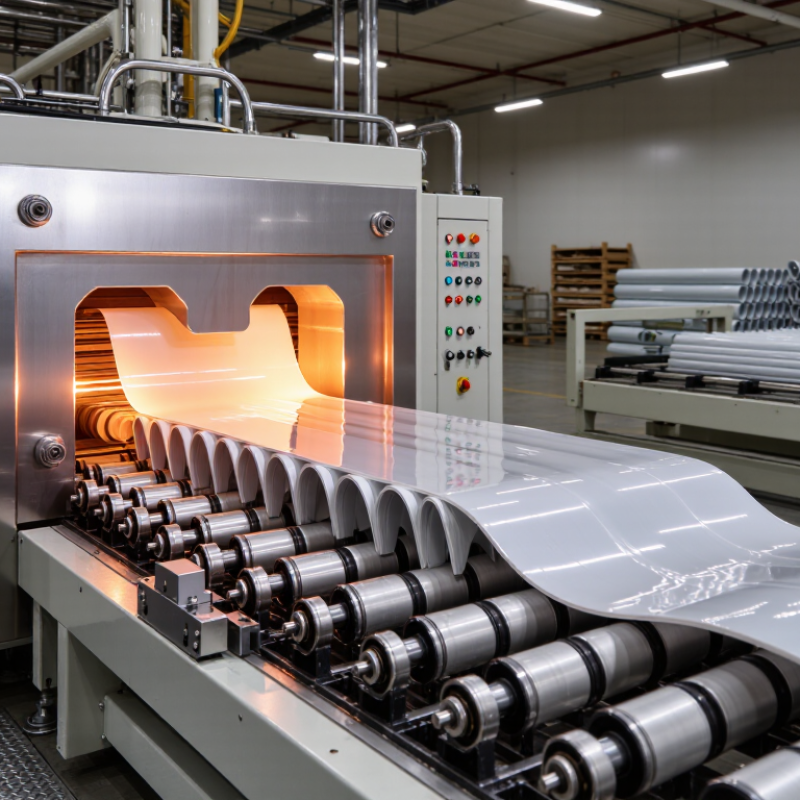
GRP Gutter Machinery Defined: Profiles Commonly Produced in 3–6 m Lengths
GRP gutter machinery produces continuous glass-reinforced plastic profiles for rainwater drainage systems. GRP combines resin with strong glass fibers. The machinery feeds these materials through a forming process called pultrusion. Continuous fibers enter a resin bath before passing through a heated die. The die shapes the material, while a puller controls movement and tension. A cutting unit then divides the finished profile into usable sections.
Straight GRP gutter profiles are commonly produced in 3–6 m lengths. These sizes balance transport, handling, installation, and joint planning. Depending on the die, machinery can produce half-round, square, or custom gutter shapes. A smooth inner surface supports efficient water flow and limits residue buildup. Operators inspect dimensions, wall thickness, resin curing, and cut accuracy throughout production. Minor temperature changes can affect profile stability. Output speed must not replace quality control. That lesson is easy to overlook.
Tips: Keep fiber tension consistent and monitor the heated die closely. Check sample profiles during every production run. Measure the first cut, not only the final batch. A small dimensional error can create visible gaps during installation. Steady adjustment usually works better than sudden machine changes.
What Is GRP Gutter Machinery and How Does It Work? - GRP Gutter Machinery Defined: Profiles Commonly Produced in 3–6 m Lengths
| Data Dimension | Typical Information | How It Relates to GRP Gutter Machinery |
|---|---|---|
| Material | Glass-reinforced plastic (GRP), also called fiberglass-reinforced polymer | The machinery forms a resin-and-glass-fiber composite into a continuous gutter profile. |
| Common Manufacturing Method | Pultrusion is commonly used for constant cross-section profiles. | Continuous fibers are impregnated with resin, shaped through a heated die, cured, and cut to length. |
| Typical Product Length | Approximately 3–6 m per finished profile | A haul-off unit and automatic cutting system can produce repeatable lengths within the selected range. |
| Profile Geometry | U-shaped, half-round, box, deep-flow, and custom drainage sections | The die determines the fixed cross-sectional shape and dimensional consistency. |
| Typical Wall Thickness | Often about 2–5 mm, depending on design, reinforcement, and load requirements | Fiber content, resin formulation, die dimensions, and production speed influence the final thickness. |
| Reinforcement | Continuous glass rovings, mats, or a combination of both | Reinforcement improves tensile strength, stiffness, dimensional stability, and resistance to impact. |
| Resin Systems | Polyester, vinyl ester, or other thermosetting resin systems | The resin provides the matrix that binds the glass fibers and cures inside the heated forming die. |
| Main Process Stages | Fiber feeding → resin impregnation → preforming → heated die forming → curing → pulling → cutting | Each stage supports continuous production and helps maintain profile dimensions. |
| Dimensional Control | Controlled by die accuracy, fiber alignment, resin ratio, curing temperature, and pulling speed | Stable process parameters reduce warping, surface defects, and variation between sections. |
| Typical Surface Finish | Smooth, pigmented, gel-coated, or lightly textured surfaces | Surface treatment can improve appearance, weathering resistance, and cleanability. |
| Key Performance Features | Low weight, corrosion resistance, electrical non-conductivity, and good dimensional stability | These characteristics make GRP suitable for exposed drainage systems and corrosive environments. |
| Common Accessories | Outlets, running outlets, end caps, corners, brackets, connectors, and expansion components | Accessories are normally produced separately by molding, machining, or secondary fabrication. |
| Typical Applications | Industrial buildings, warehouses, commercial roofs, agricultural structures, and infrastructure projects | The profile size and reinforcement level are selected according to roof area, rainfall, span, and support spacing. |
| Quality Checks | Cross-section dimensions, length, surface condition, resin cure, fiber distribution, and straightness | Inspection confirms that each 3–6 m section meets the specified design and installation requirements. |
| Important Design Note | Exact dimensions, load capacity, flow rate, and service life vary by profile design and project conditions. | Engineering calculations and applicable building or drainage standards should be used before production and installation. |
Note: The values shown are typical reference information for GRP gutter profiles; actual specifications depend on the design, resin system, reinforcement schedule, tooling, and applicable standards.
