Partner Login
Enter your username and password here on order to log in on the partner portal:
No registered partner yet?
Register nowChoosing Wooden Doors in 2026 means balancing appearance with performance, maintenance, and fit. A door may look solid in a showroom yet behave differently in a damp entryway or a sunlit hallway. The useful question is not simply which wood looks best. It is which door suits the conditions it will face.
The USDA Forest Products Laboratory’s Wood Handbook (FPL-GTR-282) explains how wood responds to moisture and how its dimensions can change. That matters in practical terms: a poorly matched door may swell, shrink, or rub against its frame as indoor humidity shifts. Small details count. Compare the wood species, core construction, finish, and manufacturer’s moisture-control guidance. Ask whether the door is intended for interior use, an exterior entrance, or a sheltered porch. These are not interchangeable situations.
Performance information deserves the same attention as style. The U.S. Department of Energy’s Energy Saver guidance recommends sealing air leaks around doors, highlighting the role of the frame, weatherstripping, and installation. WDMA’s NAFS performance standards also offer a framework for evaluating doors and related products, though ratings and suitability depend on the specific product and application. Check the documentation, not just the display label. A beautiful door can still be the wrong choice. And reports cannot inspect your doorway for you. Measure the opening carefully, consider local climate and upkeep, and confirm installation requirements before buying. This guide will help you compare those factors without pretending there is one perfect door for every home.
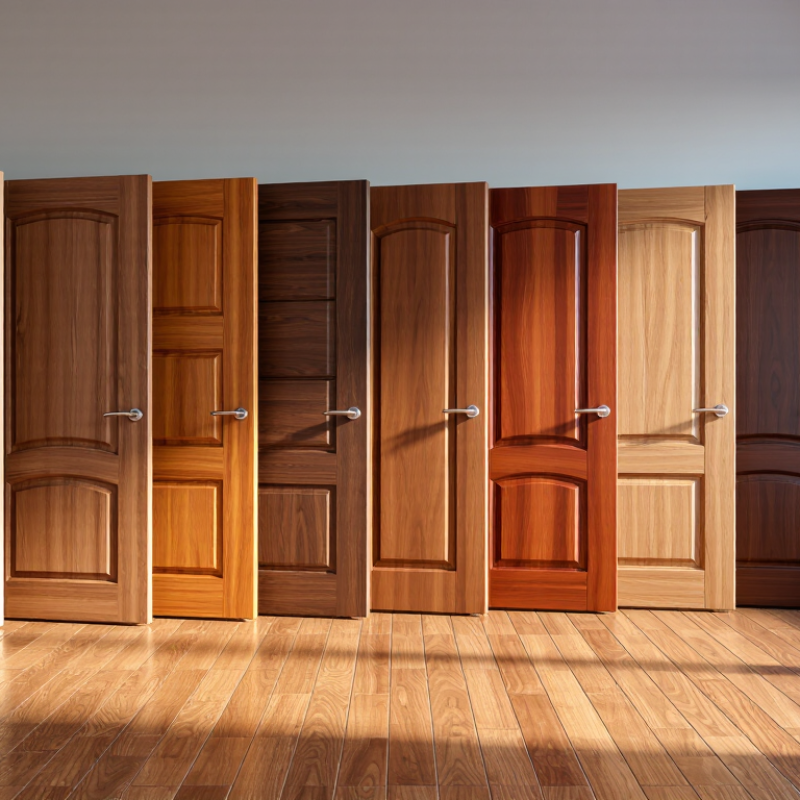
Start with the room and the door’s job. An exterior entrance faces weather, frequent use, and security demands; a bedroom door mainly needs privacy and reliable latching. A bathroom door also needs to tolerate humid air. Small detail, big effect. Note whether the door opens onto a covered porch, a sunny wall, or a cold hallway. These conditions influence wood movement, finish wear, and the hardware you’ll need. For a busy household, a durable veneer or paint-grade surface may be easier to maintain than a delicate clear finish.
Then define performance in practical terms: insulation, sound control, moisture resistance, and ease of operation. The U.S. Department of Energy’s Energy Saver guidance estimates that windows account for 25–30% of residential heating and cooling energy use. That figure applies to windows, not doors, but it underscores why exterior openings deserve careful attention. Compare a door’s U-factor and air-leakage information where available, and check how the frame and weatherstripping perform as a system. For interior rooms, a solid-core slab can reduce sound transfer, though it adds weight and may need sturdier hinges. I still find this trade-off easy to overlook: a heavy door can feel substantial, yet poor sealing can leave a draft at the threshold. Inspect the actual opening before choosing. A beautiful slab cannot fix a warped frame.
Wood species affect grain, weight, and how a door responds to humidity. Oak has a pronounced grain; maple usually looks quieter, while mahogany varies by species and grade. The USDA Forest Products Laboratory’s Wood Handbook (FPL-GTR-282, 2021) places wood’s equilibrium moisture content near 12% at 70°F and 65% relative humidity. That matters. A door can move as indoor conditions change, so a showroom sample is not a perfect preview. Solid wood offers repairable surfaces, but it can swell or shrink. Engineered cores often improve stability, though their quality depends on materials and assembly.
Match the core to the room. Hollow-core doors are lighter and often suit closets; solid-core doors feel heavier and can reduce sound transfer. For construction, inspect the edges, joints, veneer, and finish. Look for tight seams and a consistent surface, not just attractive grain. WDMA’s I.S. 6A standard covers performance requirements for architectural stile-and-rail wood doors, offering a useful reference when comparing specifications. Still, a standard cannot tell you whether a particular door fits your frame well. I would check the actual sample, especially its bottom edge and hinge area. Small flaws matter. A beautiful face can hide weak joinery.
How to Choose the Best Wooden Doors in 2026?
Measure the opening before choosing a door. Record its width at the top, middle, and bottom, then measure the height on both sides. Use the smallest readings; older frames are often slightly uneven. Check the wall thickness and note whether the door swings inward or outward. A close fit matters, but leave installation clearance as specified by the installer. Wood can expand or contract when indoor humidity changes. Easy to overlook.
Tips: Measure the frame, not an existing door that may be warped. Write down each measurement, and check them again before ordering. If the floor slopes or the frame looks twisted, ask a qualified installer to assess it.
Then compare comfort and security details. A solid or engineered wooden door can help reduce drafts, but the seal around its edges matters too. Look for even gaps and compatible weatherstripping. For security, inspect the frame, hinges, and lock preparation as a complete system; a sturdy door in a weak frame may still be vulnerable. Ask how the door should be maintained in your climate. The right finish and care can affect its appearance over time, though maintenance needs are easy to underestimate.
How to Choose the Best Wooden Doors in 2026? - Measure the Opening and Check Fit, Insulation, and Security
| What to Check | How to Measure or Inspect | Practical Target or Selection Tip | Why It Matters |
|---|---|---|---|
| Opening width | Measure the clear opening between the jambs at the top, middle, and bottom. Record the smallest measurement. | Compare the smallest measurement with the door manufacturer’s fitting instructions. Do not assume the opening matches a nominal door size. | Walls and frames can be out of square, and the narrowest point determines whether the door can fit and operate properly. |
| Opening height | Measure from the finished floor to the underside of the head jamb at the left, center, and right. | Use the smallest measurement and allow for the specified installation clearance and any flooring that will be added. | A new floor or an uneven threshold can leave too little clearance beneath the door. |
| Door slab and frame | Check whether you are replacing only the door slab or the complete prehung unit. Measure the existing slab separately from the frame. | Confirm the required slab dimensions, frame dimensions, jamb depth, hinge locations, and handing with the product specifications. | Slab size and rough-opening size are different measurements; matching only one may lead to an incompatible purchase. |
| Squareness and plumb | Measure both diagonals of the opening and use a level to check the jambs and head. | Investigate noticeably unequal diagonals or out-of-plumb jambs before ordering a close-fitting door. | An out-of-square frame can cause rubbing, uneven gaps, poor latching, and air leakage. |
| Operating clearance | Check the floor, threshold, hinges, trim, and nearby walls along the door’s swing path. | Follow the door maker’s clearance requirements; confirm the door can open fully without contacting flooring or surrounding surfaces. | Clearance needs vary with the door, frame, flooring, and installation method. |
| Insulation and energy performance | For an exterior door, review the documented U-factor, air-leakage information, and any applicable energy-rating label. | Compare tested product ratings for the complete door assembly. Lower U-factor indicates less heat transfer; weatherstripping and a well-sealed threshold also matter. | Wood species alone does not determine the performance of a complete door, which depends on its construction, glazing, seals, and installation. |
| Weather sealing | Inspect the perimeter weatherstripping, threshold, and bottom seal for continuous contact when the door is closed. | Choose replaceable, well-fitted seals and a threshold suited to the exposure and floor condition. | Gaps can allow drafts and moisture; correct adjustment and installation are essential for effective sealing. |
| Core and durability | Check whether the door is solid wood, engineered wood, or a wood-faced construction, and review its intended use and care instructions. | For high-traffic or exterior locations, prioritize a suitable construction, stable finish, and clear maintenance guidance. | Different constructions vary in weight, stability, moisture response, sound control, and maintenance needs. |
| Lock and frame security | Inspect the lock preparation, hinges, jamb condition, and the way the strike plate attaches to the frame. | Use compatible, properly installed hardware and reinforce the frame where appropriate. Follow local code and hardware instructions. | A strong door can still be vulnerable if the lock, strike, hinges, or surrounding frame are weak or poorly installed. |
| Glazing and visibility | If the door includes glass, check the glazing specification, location, and visibility from outside. | For exterior use, select glazing appropriate to the location and applicable safety requirements; consider privacy needs and secure hardware placement. | Glass affects privacy, daylight, energy performance, and the overall security design. |
Before ordering: Measure in the same units throughout, note whether measurements refer to the slab, frame, or rough opening, and verify all dimensions and performance claims against the specific product’s installation and rating documents.
A wooden door should suit the room, not just a showroom photograph. Look at the grain in daylight, and compare a sample with your floor and trim. A flat, simple profile can keep a small hallway calm; deeper panels may add character to a larger room. Check how the door swings, too. It is easy to overlook clearance until furniture gets in the way.
Finish affects both appearance and upkeep. Oil can leave the grain feeling natural, while paint gives a more even color. Test a small sample near a window, where changing light can shift its tone. Ask what cleaning and touch-up the finish needs. I would not pretend one finish works everywhere. Humidity, sunlight, and daily handling all matter.
Sustainability claims deserve a closer look. Ask for documentation showing where the wood came from, such as a recognized forest-certification standard or traceable supply-chain records. Also check whether the door can be repaired, refinished, and kept in service for years. A low-impact label alone tells only part of the story. Sometimes the better choice is the door that lasts, even if its finish is not quite perfect.
A wooden door’s price is only one part of its cost. Ask whether the quote includes fitting, hardware, finishing, and removal of the old door. A low quote may exclude these items, making comparisons misleading. Solid wood can cost more upfront, while engineered wood may offer a steadier price and fewer seasonal movements. Check the frame and installation details, too. Small details matter.
Read the warranty before comparing offers. Look for the covered period, eligible repairs, and exclusions for moisture, poor installation, or neglected finishes. A long warranty is not automatically better if labor or surface damage is excluded. Ask who handles claims and keep the receipt and care instructions. Get the answer in writing.
Maintenance depends on the door’s finish, exposure, and local conditions. Exterior doors facing strong sun or rain may need closer inspection than sheltered interior doors. Check edges, joints, and the bottom of the door for peeling or swelling, especially after wet weather. Cleaning and occasional refinishing can add costs over time. I would not call the cheapest option the best value without estimating those costs; that estimate can still be imperfect. A simple comparison sheet can help: purchase and fitting costs, warranty limits, and likely upkeep over several years.