Partner Login
Enter your username and password here on order to log in on the partner portal:
No registered partner yet?
Register nowChina’s solar market is expanding, but a capable On Grid Controller is more than a box beside an inverter. It helps coordinate power conversion, grid synchronization, and protective responses. Small differences matter: communication protocols, operating ranges, firmware support, and service access can shape performance after installation. This 2026 guide compares ten China-based manufacturers through those practical considerations, rather than treating a product brochure as proof of reliability.
A useful editorial principle, consistent with the power-systems work of Dr. Saifur Rahman, is: “Grid integration depends on coordinated control, not hardware alone.” This is a paraphrase, not a verbatim quotation. It points to a central question for buyers: how well does each controller work with the inverter, monitoring platform, and site requirements? Product documentation, certification details, technical support, and real deployment evidence deserve close review. Names and rankings can change; verification matters.
No single shortlist fits every project. A utility-scale site may prioritize system coordination and long-term service, while a commercial rooftop installation may need simpler commissioning and clear monitoring. Even a well-specified controller can disappoint when integration details are overlooked. That is an easy mistake to make. The following outline introduces manufacturers and comparison points, while recognizing that public information may be incomplete and specifications can change. Readers should confirm current product data directly with manufacturers before making procurement decisions.
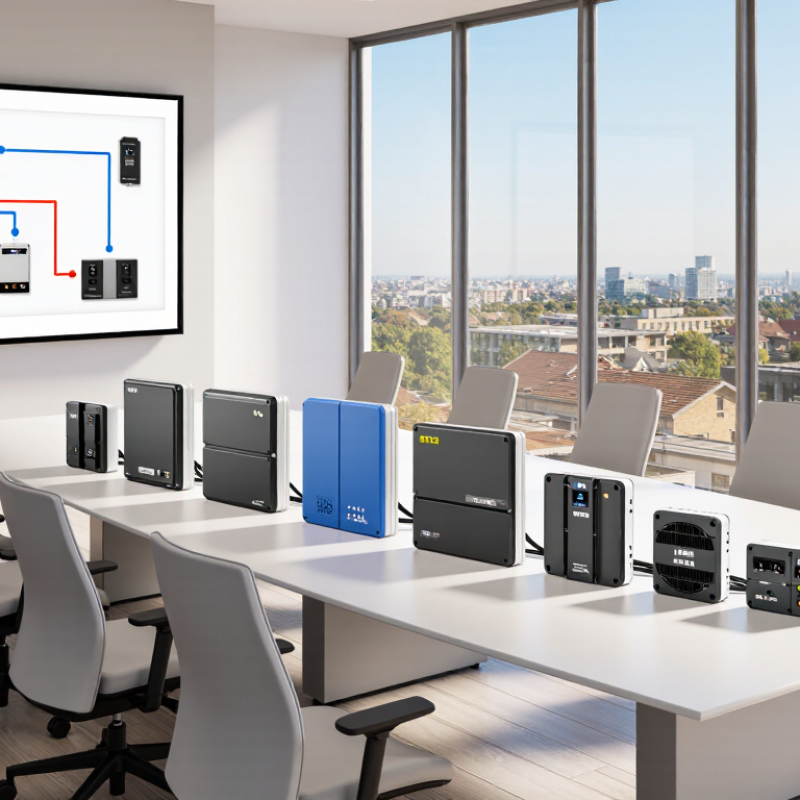
What an On-Grid Controller Does in a Grid-Connected System
An on-grid controller coordinates power flow between a renewable-energy system, local loads, and the utility grid. It reads measurements from meters and sensors, then sends operating commands to compatible inverters. In practical terms, it can limit export when a site approaches its agreed power cap. It can also adjust active and reactive power to support voltage control, where the equipment and grid requirements allow. The controller is not a substitute for electrical protection. Instead, it works alongside protective devices and inverter functions to respond to abnormal grid conditions.
This role matters as installations grow. IRENA’s Renewable Capacity Statistics 2024 reports that renewable power capacity increased by 473 GW in 2023, representing 86% of total global power-capacity additions that year. More generation connected to distribution networks means tighter coordination between equipment and grid operators. A controller can use real-time readings to reduce output during an export limit or coordinate several inverters. Yet performance depends on correct settings, reliable communications, and commissioning. A dashboard may look reassuring while a mismatched meter quietly feeds the wrong data.
Tips: Check meter direction and phase mapping during commissioning. Test export limits under changing load. Small errors matter.
An on-grid controller helps a solar system match its output to the utility grid. It monitors voltage, frequency, and power flow in real time. When conditions are stable, it coordinates inverter output so electricity can be used onsite or exported. If grid values move outside configured limits, the controller can adjust output or trigger disconnection. That response protects equipment and supports a stable connection. Small timing differences matter.
During commissioning, technicians check sensor placement, communication links, and export settings. A meter installed in the wrong position can misread household demand. The controller may then limit generation unnecessarily. I have seen how a tidy dashboard can still hide a poor measurement point. Data needs physical verification.
Tips: Confirm the controller supports the inverter and meter configuration. Test grid-loss response and export limits during commissioning. Keep firmware and settings documented. For buyers comparing manufacturers in 2026, ask for clear operating ranges, fault records, and practical service guidance. A specification sheet is useful, but real operating data is better.
Choosing an on-grid controller manufacturer requires more than comparing rated power and price. The IEA’s Renewables 2024 report says global renewable capacity additions reached nearly 510 GW in 2023, with solar accounting for about three-quarters. That growth raises the value of controllers that can manage changing grid conditions reliably. Ask manufacturers for test reports covering voltage and frequency response, reactive power control, harmonic distortion, and anti-islanding behavior. Check that tests match the grid codes and operating conditions of your project.
Look beyond a polished datasheet. Request evidence from accredited laboratories, production quality records, and traceable component checks. Ask how firmware updates are validated and how faults are diagnosed from logged operating data. A useful factory audit might inspect temperature testing, wiring consistency, and serial-number records—not just a demonstration unit. No datasheet tells the whole story. Field reliability data can be incomplete, so compare the manufacturer’s claims with independently verified test results and references from installations of similar size and climate.
Service capability matters too. Confirm response times, spare-parts availability, and technical support in your language and time zone. Evaluate whether the controller can integrate with the project’s inverters, meters, and monitoring platform without custom workarounds. Lower cost may look attractive, but unclear warranty terms or limited grid-code documentation can create delays later. I would still treat forecasts cautiously; site conditions often expose gaps that laboratory tests miss.
China’s Top 10 On-Grid Controller Manufacturers for 2026 reflects a market shaped by larger solar installations, tighter grid requirements, and demand for dependable power conversion. A controller must do more than match panels to the grid. It needs to manage voltage and frequency, respond to changing sunlight, and communicate clearly with monitoring systems. In practice, installers notice small details: readable fault codes, accessible terminals, and stable operation during cloudy afternoons.
A useful comparison looks beyond rated output. Buyers can review conversion efficiency across different loads, protection features, operating temperature ranges, and compatibility with site equipment. Ask manufacturers for test reports, warranty terms, and local technical support arrangements. These details are easier to verify than broad performance claims. Field experience matters. A unit that performs well in a laboratory may still need careful commissioning on a rooftop with long cable runs or uneven panel exposure.
There is no perfect ranking. Product lines change, and public specifications may not reveal long-term service performance. That is worth remembering. For 2026, the strongest candidates are likely to combine documented testing with practical installation guidance and responsive after-sales support. Request recent project references, then compare how each supplier handles troubleshooting, firmware updates, and replacement parts. Small oversights can become costly. A careful review helps distinguish robust engineering from attractive brochure figures.
In 2026, on-grid controllers are becoming practical tools for managing changing power flows, not just connecting solar equipment. On commercial rooftops, they can coordinate inverters, meters, and battery systems to limit export when site demand falls. A factory may use live meter readings to keep solar output within its agreed connection capacity. That matters on bright, low-load afternoons. Details matter.
Utility-scale projects use controllers to adjust active and reactive power as grid conditions change. Newer systems increasingly support functions such as voltage response, frequency control, and remote monitoring. Their performance depends on sound measurement, reliable communications, and carefully tested settings. A sensor delay can turn a useful control loop into a source of instability. More data does not always mean better control.
Market demand is also shifting toward interoperability and clearer operational visibility. Project owners want systems that work across equipment types and make faults easier to diagnose. Cybersecurity and software updates deserve attention throughout a controller’s service life, not only at commissioning. Hybrid solar-and-storage sites add another challenge: charging, export limits, and grid support must be coordinated without confusing operators. These trends are uneven across regions, and local grid requirements still shape system design. A controller is only as dependable as its configuration and the measurements feeding it.
Application and technology comparison for ten on-grid controller solution categories. Entries describe common deployment needs and market directions; they are not a verified ranking of companies or brands.
| No. | Controller Solution Category | Typical Application | Main Control Requirements | Grid Interface | 2026 Market Trend |
|---|---|---|---|---|---|
| 1 | Residential rooftop PV | Household grid-connected solar systems | Power conversion coordination, export limiting where required, monitoring, and safe disconnection during grid faults | Low-voltage distribution network | More emphasis on self-consumption, remote monitoring, and coordination with home energy storage |
| 2 | Commercial rooftop PV | Offices, retail buildings, and logistics facilities | Multiple inverter coordination, site-level metering, power-factor control, and demand-load coordination | Low-voltage or customer-side medium-voltage connection | Controllers increasingly integrate PV, building loads, and storage to improve on-site energy use |
| 3 | Industrial rooftop PV | Factories and energy-intensive industrial sites | Coordinated control of generation, plant demand, reactive power, and export limits | Customer-side distribution grid, often with medium-voltage equipment | Growing demand for plant-level energy management and integration with industrial monitoring systems |
| 4 | Utility-scale PV plant controller | Large, centralized grid-connected solar plants | Plant-level active and reactive power control, ramp-rate management, inverter coordination, and dispatch communication | Substation and transmission or regional distribution grid | Greater focus on grid-support functions, forecasting interfaces, and compliance with project-specific grid requirements |
| 5 | PV-plus-storage controller | Commercial, industrial, and utility projects combining solar PV and batteries | Coordination of PV output, battery charging and discharging, grid import or export, and operating limits | Grid-connected AC or DC coupled system, depending on project design | Increasing need for interoperable controls that manage variable generation and storage without compromising battery limits |
| 6 | Weak-grid and remote-area controller | Renewable projects connected to electrically weak or remote networks | Voltage and frequency support, controlled power changes, fault response, and coordination with available grid resources | Weak distribution or remote grid connection | More attention to stable operation under voltage fluctuations and to coordinated controls where storage is present |
| 7 | Floating PV controller | Solar installations on reservoirs and other suitable water bodies | Inverter and plant coordination, output monitoring, communications supervision, and grid-support control | Grid connection through the project’s land-based electrical infrastructure | Control design increasingly accounts for remote equipment monitoring and reliable communications across the site |
| 8 | Agrivoltaic controller | PV projects that share land with agricultural activities | PV output and grid-interface control, with monitoring suited to distributed equipment and site conditions | Distribution or sub-transmission connection, depending on project scale | Projects require adaptable monitoring and controls alongside site-specific land-use and operational planning |
| 9 | PV and EV charging controller | Workplace, commercial, and fleet charging sites with on-site solar | Coordination of PV output, charger demand, site import limits, and optional battery operation | Customer-side distribution grid | Energy management increasingly links charging schedules with solar availability and site capacity constraints |
| 10 | Grid-connected microgrid controller | Campuses, industrial parks, and local energy systems with grid and on-site resources | Coordination of PV, storage, controllable loads, and grid exchange; transitions depend on system design and protection scheme | Point of common coupling with the utility network | Demand is rising for integrated supervisory control, clear device interoperability, and secure operational communications |
Note: Actual controller functions and grid-connection settings depend on the project design, equipment certification, utility requirements, and applicable standards.