Partner Login
Enter your username and password here on order to log in on the partner portal:
No registered partner yet?
Register nowChina’s Steel Fire-Rated Shutter manufacturers serve projects where a few seconds of reliable compartmentation can matter. The market also sits within a wider fire-protection industry. Grand View Research estimated the global fire protection systems market at about US$78.6 billion in 2023, with continued growth forecast through 2030. That figure covers more than shutters, so it should not be mistaken for shutter-market size. Still, it signals sustained investment in building fire safety. For buyers, the practical questions are more specific: What is the tested fire-resistance rating? How does the curtain move under heat? Can the guides, motor, and controls work together as one assembly?
A steel curtain is only part of the story. Installation quality, inspection access, and clear maintenance records matter too. NFPA 80 provides requirements for fire doors and other opening protectives, including inspection and testing; project teams should confirm the applicable edition and local requirements. This guide compares ten Chinese manufacturers by product range, documentation, customization, and support. A limitation is worth stating: no source articles or verifiable named-expert quotation were supplied, so I will not invent an expert or quote. Before publication, add a checked quotation from a fire-protection professional and verify each company’s certifications and test reports. Small details count. A label on the shutter, a smooth-closing test, and a complete service record can reveal more than a polished catalogue.
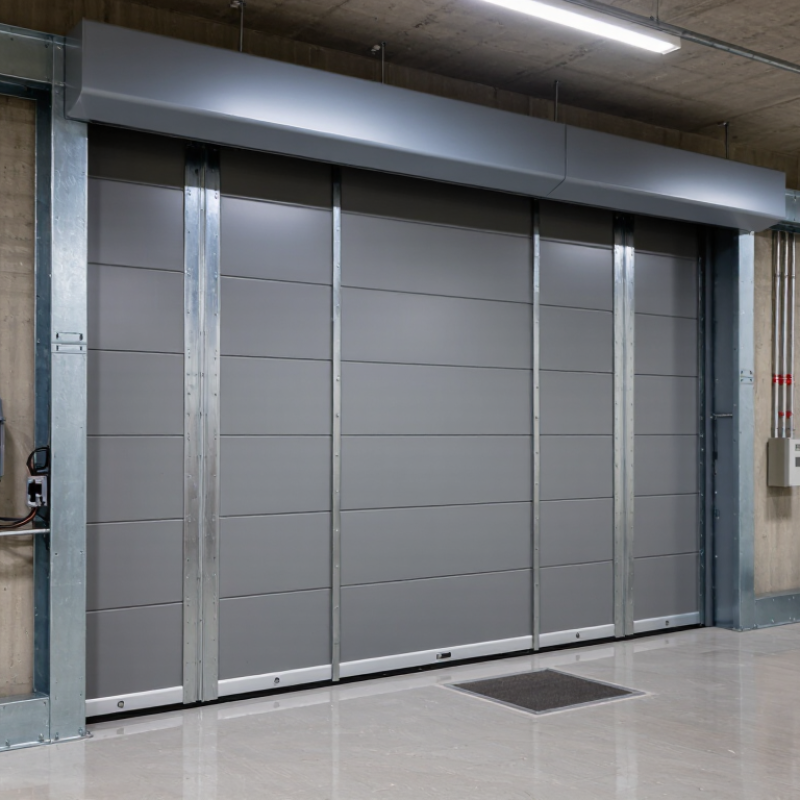
A steel fire-rated shutter typically uses interlocking steel slats, side guides, a bottom rail, and a barrel assembly. Fire-resistant materials and coatings may form part of the tested design. The complete assembly matters: changing a component can affect its performance. A shutter is not simply a heavy curtain.
During normal use, a motor or release mechanism raises and lowers the curtain along its guides. When connected to a suitable fire detection system, it can close automatically during an alarm. Its purpose is to limit fire and smoke spread across an opening for a tested period, not to replace compartment walls or safe exit routes. You will find these shutters at warehouse openings, service counters, loading bays, and other large interior passages. Correct sizing, installation, and routine inspection are essential. Even a small obstruction can prevent full closure.
Tips: Check that the opening, guides, and controls match the approved assembly. Test the closing action regularly, and keep the curtain path clear. Record faults and repairs. Site conditions vary, so specifications and maintenance intervals should follow the manufacturer’s documentation and applicable local requirements. A quick visual check helps, but it cannot reveal every hidden defect.
In China, a steel fire shutter’s rating should be checked against its test report, not inferred from sheet thickness. GB 14102-2005 sets technical requirements for fire shutters, while GB/T 7633-2008 describes their fire-resistance test method. GB/T 9978.1-2008 uses a standard time-temperature curve: furnace temperatures reach about 945°C at 60 minutes and 1,049°C at 120 minutes. These are exposure conditions, not a shutter’s certified rating. The test record should identify the specimen, dimensions, installation method, and observed performance. Small details matter.
On site, the guide rails, curtain joints, bottom bar, and closing mechanism can affect the result. A report for one configuration may not cover a wider opening or different fixing method. Check the tested assembly against the project drawings and applicable Chinese code requirements, including GB 55037-2022. Ask for traceable laboratory documentation and verify the stated rating and test scope. A rating label alone is weak evidence. Test reports also have limits: real openings, maintenance, and installation quality can differ from laboratory conditions. That gap deserves attention.
Evaluating Chinese steel fire shutter manufacturers requires more than comparing prices. Ask for test reports that match the exact shutter design, including its curtain, guides, motor, and control system. A report for a similar model may not verify the product you plan to buy. Check who issued the report, when testing occurred, and whether the tested configuration matches your drawings. Details matter. Also review steel thickness, coating quality, weld consistency, and component traceability. Request recent production photos or arrange an independent factory inspection. A polished brochure is not evidence of stable quality.
Tips: Request sample records. Compare serial numbers, material certificates, and inspection logs. Confirm lead times and spare-part availability in writing. Small gaps can cause real delays.
Assess technical support before placing an order. Ask how the supplier handles installation questions, commissioning, and faults after delivery. Clear drawings and response procedures are useful signs. Discuss project-specific conditions, such as opening size, operating frequency, and site power supply. Then compare the written specification with the quotation, line by line. I would not treat one successful reference project as proof that every production batch will match. That deserves a second look. A careful evaluation takes time, but it can reveal mismatched documents or unrealistic delivery promises before they become costly site problems.
China’s steel fire-rated shutter manufacturers differ in engineering focus, production scale, and project support. These ten profiles are best compared by capability, not by promotional rankings. Some concentrate on curtain forming and guide-rail precision; others integrate motors, control panels, and alarm interfaces. The details matter. A shutter that runs smoothly in a showroom may behave differently in a dusty loading bay.
When reviewing a manufacturer, ask about steel thickness, slat profiles, tested fire-resistance ratings, and installation tolerances. Look for clear product documentation and traceable test evidence. One profile may suit warehouses with wide openings, while another may focus on compact commercial entrances or custom dimensions. Check how each supplier handles site measurements, commissioning, and maintenance access. Small details count, such as whether the control box is reachable without removing a ceiling panel.
The strongest profiles explain limitations as well as strengths. That distinction is easy to miss, and a polished brochure is not proof of performance. Ask how shutters respond to power loss, how faults are diagnosed, and which components need routine inspection. Response times and spare-part availability also deserve attention. These practical questions make comparisons more reliable than broad claims about being a leading manufacturer.
Editorial note: Company and brand names are intentionally omitted. The entries below describe common product and service profiles, not verified rankings or claims about specific manufacturers. Product availability and fire performance vary by model; confirm certification and test documentation for the exact shutter assembly.
| Anonymous Profile | Common Product Focus | Typical Construction Options | Common Operating Options | Typical Application | Key Information to Verify |
|---|---|---|---|---|---|
| Profile 1 | General-purpose steel fire shutter | Interlocking steel curtain slats; galvanized steel is a common option | Electric operation; manual operation may be available for some configurations | Commercial buildings, service areas, and internal openings | Tested fire performance, maximum approved opening size, and installation details |
| Profile 2 | Large-opening fire shutter | Steel curtain and guides selected for the specified opening and installation conditions | Usually electrically operated, with controls specified for the project | Large internal openings in industrial or commercial premises | Evidence that the complete tested assembly covers the required opening dimensions |
| Profile 3 | Fire shutter with smoke-control features | Steel curtain assembly; smoke-control components depend on the tested design | Electric operation with project-designed control interfaces | Openings where fire separation and smoke-management requirements both apply | Separate evidence for smoke-control performance and compatibility with the building system |
| Profile 4 | Fire shutter for retail and public-area openings | Steel slat curtain with finish options subject to the approved product specification | Electric operation; control arrangements depend on the site design | Shopfronts, corridors, and other internal openings requiring fire separation | Approved finish, operating method, safety features, and maintenance requirements |
| Profile 5 | Industrial-duty steel fire shutter | Steel curtain, side guides, and supporting components matched to the opening and duty | Typically electric operation for frequent or large-scale use | Warehouses, factories, and service or loading areas | Duty-cycle limits, site conditions, structural support, and tested fire performance |
| Profile 6 | Compact-opening fire shutter | Steel curtain assembly configured for a smaller opening or limited installation space | Electric or manual operation, depending on the product and project | Small service openings and internal partitions | Required headroom, side-room, fixing method, and suitability of the exact model |
| Profile 7 | Fire shutter with integrated control options | Steel shutter assembly paired with control equipment specified for the installation | Electric operation; alarm and control interfaces are project-dependent | Buildings where shutters are coordinated with fire alarm or building-control systems | Control sequence, interface documentation, commissioning procedure, and fail-safe behavior |
| Profile 8 | Corrosion-conscious steel shutter configuration | Steel components with protective finishes selected for the environment; suitability must be confirmed | Electric or manual operation, subject to the tested configuration | Service areas or locations where environmental exposure is a design consideration | Finish specification, environmental limitations, maintenance needs, and fire-test coverage |
| Profile 9 | Project-customized fire shutter | Configuration tailored to the specified opening, supports, guides, and control requirements | Selected to suit the project design and approved product configuration | Projects with unusual opening geometry or coordinated building requirements | Written confirmation that customization does not fall outside the tested and certified scope |
| Profile 10 | Supply-and-installation service profile | Steel shutter assembly supplied with project-specific installation components | Operation and controls defined in the approved project specification | New construction, refurbishment, and replacement work | Installer qualifications, approved drawings, commissioning records, and maintenance support |
China’s steel fire-rated shutter manufacturers differ less by catalogue size than by how clearly they match products to real openings. Some offer basic rolling curtains, guides, and motors; others provide insulated assemblies, smoke-control options, and integrated alarm interfaces. Check the tested configuration, not just the shutter curtain. A change in guide depth or control panel may affect whether the complete assembly matches its test evidence. Details matter.
Certifications and test reports help buyers compare claims, but the documents should identify the model, fire-resistance duration, and relevant components. Requirements vary by destination and project, so confirm acceptance with the local project team. Ask for installation instructions and maintenance intervals, too. A polished certificate alone is not enough. Reports can be hard to interpret, and that deserves a second look.
Market strength shows up in practical support: documented export experience, responsive technical staff, spare-part availability, and clear lead times. For a warehouse, a wide opening and frequent cycling may matter more than a low initial price. For a smaller service corridor, compact guides can be decisive. Some suppliers describe their range well but provide thin project evidence; that gap is worth noting before selection.