X

Partner Login

Enter your username and password here on order to log in on the partner portal:

No registered partner yet?

Register now

China Best 3 Phase Brushless DC Motor Manufacturer?

Choosing China’s best 3 Phase Brushless Dc Motor manufacturer requires more than comparing prices. A reliable supplier should demonstrate engineering depth, stable production, and measurable testing results. Buyers should inspect torque curves, winding data, rotor balance records, insulation tests, and controller compatibility. A polished website is not enough.

Dr. R. Krishnan, a widely cited motor-drive researcher, states, “A motor drive must be evaluated as a complete electromechanical system.” This principle matters when selecting a 3 Phase Brushless Dc Motor for automation, robotics, pumps, or electric vehicles. The motor, inverter, sensors, firmware, and cooling method must work together. Otherwise, impressive laboratory figures may fail under continuous industrial loads.

Look closely at the factory floor. Are copper wires wound consistently? Are magnets bonded securely? Does each production batch receive vibration and temperature testing? These details reveal practical manufacturing competence. Certifications can support trust, but they do not replace traceable test reports or responsive technical support.

The strongest Chinese manufacturers usually offer customized shafts, voltage options, Hall sensors, encoders, and IP-rated housings. They should also explain expected efficiency at specific speeds, not only advertise a maximum value. That difference is important.

There is no universal “best” supplier. An excellent motor for a conveyor may be unsuitable for a medical pump. This article compares leading manufacturers through performance, quality control, customization, delivery capability, and after-sales support. Some conclusions may remain imperfect, because supplier data can change and independent verification is not always complete. Careful buyers should request samples before approving large orders.
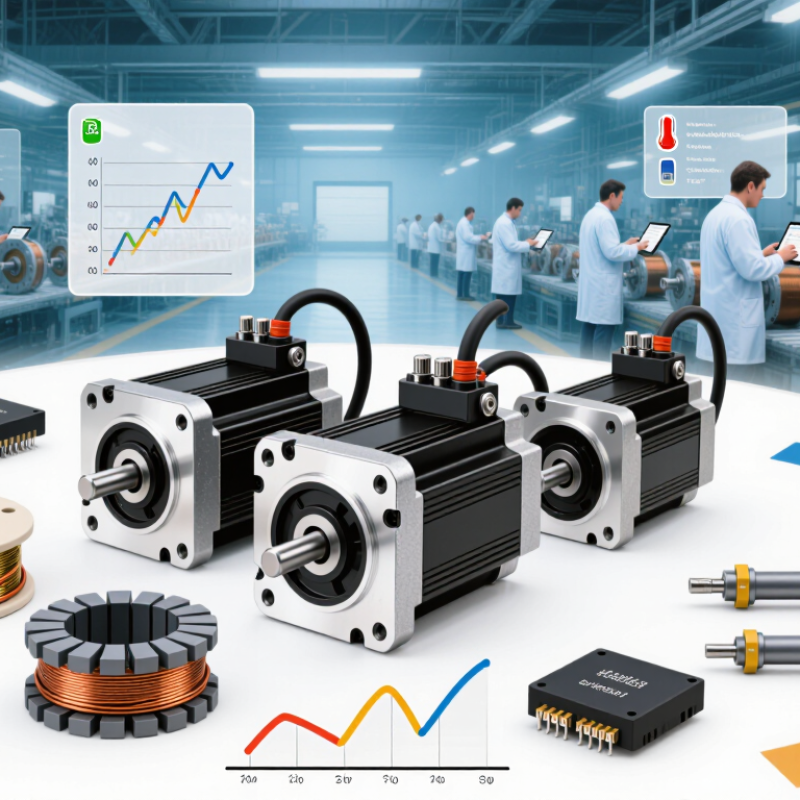
China Best 3 Phase Brushless DC Motor Manufacturer?

What Is a Three-Phase Brushless DC Motor?

A three-phase brushless DC motor converts electrical energy into controlled rotary motion without mechanical brushes. Its stator contains three windings arranged around the housing. A permanent-magnet rotor turns inside these windings. An electronic controller switches current between the phases, creating a rotating magnetic field.

The switching sequence is called electronic commutation. Hall sensors can report the rotor position, while sensorless control estimates position from back electromotive force. Six-step control is common because it is simple and economical. Field-oriented control can produce smoother torque and quieter operation. In a workshop, the difference is noticeable: a poorly tuned motor may vibrate near low speed, while a suitable controller starts more evenly.

These motors suit pumps, cooling fans, automation equipment, and electric tools. Their efficiency depends on winding design, load, voltage, and controller settings. Heat matters too. A compact motor may feel acceptable during a short test but overheat after continuous operation. I once underestimated this point. The casing stayed cool, yet the winding temperature rose quickly under repeated starts. Engineers should check rated current, peak torque, speed range, insulation, and cooling conditions before selection. Dust, moisture, and misalignment also affect service life. The phrase “brushless” does not mean maintenance-free. Bearings still wear, connectors loosen, and control software may need adjustment.

What Is a Three-Phase Brushless DC Motor?

This chart shows the ideal six-step commutation sequence of a three-phase brushless DC motor over one electrical revolution. At each 60° sector, two phases are energized with opposite polarity while the third phase is unpowered. The electronic controller switches the phases according to rotor position, commonly detected by Hall sensors or estimated from back electromotive force.

How Does a Three-Phase BLDC Motor Work?

China Best 3 Phase Brushless DC Motor Manufacturer?

How Does a Three-Phase BLDC Motor Work?

A three-phase BLDC motor uses electronic switching instead of mechanical brushes. Its stator contains three coil groups, spaced 120 electrical degrees apart. A controller energizes these coils in sequence. The changing magnetic field pulls the permanent-magnet rotor around the stator. Hall sensors or sensorless control estimates rotor position. Then, the inverter changes current timing within milliseconds.

This process creates smooth torque with fewer wearing parts. In factory testing, correct phase timing reduces vibration and heat. Poor timing does the opposite. The IEA reports that electric motor systems consume about 53% of global electricity. The U.S. Department of Energy also identifies motor-driven equipment as a major share of industrial electricity use. These figures explain why efficiency matters beyond the motor itself. Cable size, controller losses, load patterns, and cooling all affect real performance.

Tips: Check rated voltage, continuous torque, peak torque, and controller compatibility. Measure winding resistance across all phases. Unequal readings may reveal a damaged winding. Keep the rotor and sensor alignment precise. I have seen motors run quietly during no-load tests, then overheat under sudden loads. That result is easy to overlook. A BLDC motor is not automatically efficient in every application. The complete drive system decides the outcome.

Key Performance Factors for Comparing Manufacturers

China Best 3 Phase Brushless DC Motor Manufacturer?

Key Performance Factors for Comparing Manufacturers

A capable manufacturer should prove performance beyond a catalog speed. The International Energy Agency reports that electric motor systems consume roughly half of global electricity. Efficiency therefore matters at real operating loads, not only at the rated point. Request efficiency, torque, current, and temperature data at 25%, 50%, 75%, and 100% load. Testing aligned with IEC 60034-2-1 makes comparisons more credible. Some suppliers provide impressive peak figures. Peak figures can mislead.

Thermal behavior deserves close inspection. Ask for winding temperature rise, insulation class, demagnetization limits, and continuous torque during repeated starts. A three-phase BLDC motor should also match the controller’s voltage, commutation method, encoder feedback, and protection logic. Poor matching can create vibration, audible noise, or early bearing wear. Check rotor balance grades, shaft runout, bearing specifications, and IP protection. Small details matter.

Manufacturing evidence separates engineering from sales language. Review sample test records, calibration dates, batch traceability, and failure-analysis procedures. The U.S. Department of Energy identifies motor-driven systems as a major industrial energy load, reinforcing the value of verified efficiency and maintenance data. Ask whether production units receive end-of-line testing, including phase resistance, back-EMF symmetry, insulation resistance, and no-load current. I would still inspect several samples independently; one report never represents an entire factory.

Major Applications of Three-Phase BLDC Motors

Three-phase BLDC motors serve applications that need efficient, controlled, and reliable rotation. Their electronic commutation reduces brush wear and supports steady speed. Technicians commonly use them in HVAC blowers, industrial fans, pumps, and air-handling units. It runs quietly. In a ventilation system, a controller can adjust motor speed as airflow demand changes. This reduces unnecessary energy use and limits sudden mechanical stress.

Factories also use these motors in conveyors, packaging machines, robotic joints, and automated guided vehicles. Their compact design fits equipment with limited installation space. Precise feedback from Hall sensors or encoders helps maintain stable movement. A conveyor may need slow starting, accurate stopping, and repeated operation for many hours. Three-phase control handles these demands well, but poor tuning can create vibration, noise, or excess heat.

Electric bicycles, cooling systems, medical equipment, and agricultural pumps represent other practical uses. Each application requires careful matching of voltage, torque, speed, and operating temperature. Engineers should check the motor controller, load profile, bearing protection, and enclosure rating together. Not every load fits. In dusty workshops, inadequate sealing can shorten service life. Field inspections should record current, temperature, vibration, and connection quality. One detail is easy to miss: a motor may appear efficient while the controller wastes energy through poor settings. Testing under real conditions remains more dependable than relying only on catalog data.

China Best 3 Phase Brushless DC Motor Manufacturer? - Major Applications of Three-Phase BLDC Motors

Application Area Typical Equipment Common Rated Voltage Typical Power Range Typical Speed Range Why Three-Phase BLDC Motors Are Used Important Selection Factors
Industrial Automation Conveyors, indexing systems, feeders and compact production machinery 24–96 VDC 100 W–5 kW 500–4,000 rpm High efficiency, precise speed control, low maintenance and good dynamic response Continuous-duty rating, encoder compatibility, overload capacity and required torque at low speed
Robotics and AGV Systems Autonomous guided vehicles, mobile robots, robotic joints and drive wheels 24–80 VDC 200 W–3 kW per motor 300–3,000 rpm High torque density, regenerative braking capability and compatibility with battery-powered systems Peak torque, braking performance, position feedback, thermal limits and battery voltage
HVAC and Ventilation Air handlers, centrifugal fans, ventilation units and heat-pump blowers 24–400 VDC 100 W–10 kW 500–3,600 rpm Efficient variable-speed operation, reduced acoustic noise and lower energy consumption at part load Fan load curve, acoustic requirements, ingress protection, continuous operation and controller integration
Pumps and Fluid Handling Water circulation pumps, dosing pumps, coolant pumps and process pumps 24–400 VDC 100 W–15 kW 500–3,600 rpm Stable speed regulation, compact construction and improved efficiency compared with many brushed motor designs Required flow and head, wet-environment protection, corrosion resistance, seal arrangement and duty cycle
Electric Vehicles and Mobility Electric scooters, light utility vehicles, traction systems and auxiliary drives 48–800 VDC 500 W–100 kW 1,000–8,000 rpm High power-to-weight ratio, efficient operation, regenerative braking and reliable electronic commutation Peak and continuous torque, cooling method, battery architecture, controller communication and safety requirements
Renewable Energy Equipment Small wind generators, solar-tracking systems and energy-storage auxiliaries 48–600 VDC 500 W–50 kW 300–3,000 rpm High efficiency, low maintenance and controllable operation under changing load conditions Generator or motor operating mode, outdoor protection, temperature range, overspeed protection and service life
Medical and Laboratory Equipment Ventilators, centrifuges, pumps, dental systems and analytical instruments 24–230 VDC 50 W–3 kW 500–20,000 rpm Low vibration, accurate speed control, low electromagnetic noise and reduced maintenance requirements Speed stability, vibration level, acoustic noise, cleanliness, insulation system and applicable safety standards
Machine Tools Spindles, cutting equipment, grinding machines and auxiliary axes 200–600 VDC 1–50 kW 1,000–24,000 rpm Wide speed range, high acceleration, precise control and strong power density Spindle torque curve, maximum speed, bearing arrangement, cooling method, encoder resolution and duty cycle
Printing and Packaging Rollers, labeling machines, winding systems and packaging conveyors 48–400 VDC 200 W–10 kW 500–5,000 rpm Accurate synchronization, fast response, repeatable positioning and reliable continuous operation Speed synchronization, tension control, stop-and-start frequency, feedback type and overload performance
Household and Commercial Appliances Refrigeration compressors, washing machines, air purifiers and high-efficiency fans 24–400 VDC 50 W–3 kW 500–6,000 rpm Energy efficiency, compact size, lower maintenance and variable-speed operation Noise and vibration, cost target, thermal management, controller size, efficiency requirements and production volume
Marine and Outdoor Systems Electric winches, marine pumps, navigation auxiliaries and outdoor actuators 24–96 VDC 200 W–20 kW 300–3,600 rpm Reliable operation, high torque density and suitability for sealed, battery-powered equipment Ingress protection, salt-mist resistance, corrosion protection, shock and vibration rating and emergency braking
Cooling and Thermal Management Battery cooling pumps, liquid-cooling fans, server cooling and industrial chillers 12–400 VDC 30 W–5 kW 500–8,000 rpm Efficient variable-speed control, compact packaging and dependable operation over long service periods Flow-rate requirement, coolant compatibility, temperature range, sealing, acoustic noise and continuous-duty rating

Note: Voltage, power and speed values are typical engineering ranges for three-phase BLDC motor applications. Actual specifications depend on the motor design, controller, cooling method, load profile and applicable industry standards.

How to Select the Best Chinese BLDC Motor Manufacturer

Selecting the best Chinese BLDC motor manufacturer requires more than comparing quotations. The IEA estimates that electric motor systems consume about 46% of global electricity. Efficiency, therefore, affects operating cost and emissions. Review the manufacturer’s three-phase test records, torque-speed curves, winding temperature data, and no-load current. Ask for samples from the same production line. A polished prototype can hide weak process control.

Grand View Research projects strong BLDC market growth through 2030, with demand rising in automation, appliances, and electric mobility. This growth makes supplier quality more important. Check ISO 9001 certification, incoming-material controls, rotor balancing, and end-of-line inspection. Request IEC 60034-related test evidence where applicable. Also inspect magnet bonding, bearing fit, insulation resistance, and controller compatibility. Factory experience matters. Yet, I would not treat years in business as proof of reliability; recent batch data is more useful.

Tips: Compare at least three suppliers using identical specifications. Require a signed drawing, tolerance table, warranty terms, and corrective-action procedure. Visit the facility if possible. Listen for uneven bearing noise during testing. It is a small detail, but it may reveal larger process problems. Ask how the supplier handles failures, not only how it presents success.