What Is the Best Rice Harvesting Equipment in 2026?
Choosing the best Rice Harvesting Equipment in 2026 depends less on a single “top” machine and more on the field, crop, and farm operation. A modern combine harvester can cut, thresh, and clean rice in one pass, reducing handling across large, accessible fields. Smaller plots, soft ground, or narrow bunds may call for a compact harvester or a reaper paired with separate threshing equipment. The best fit is practical, not always the most powerful.
Compare machines by cutting width, field capacity, grain loss, fuel use, and performance in wet conditions. Check whether the machine can move safely through your field, turn at its edges, and handle the expected crop volume. Ask dealers for service coverage, parts availability, operator training, and warranty terms. If possible, inspect a demonstration in conditions resembling your own. A clean brochure photo cannot tell you how a machine behaves in soft, muddy soil.
This guide examines common equipment types and the trade-offs behind them, then explains how to match a machine to farm size, terrain, budget, and labor. Published specifications are useful, but test results can vary with crop moisture, settings, and operator skill. Even a careful comparison has limits. A machine that saves time may bring higher repair costs or require skilled maintenance. There is no perfect formula, and some farm-specific details are easy to overlook. Use the recommendations as a starting point, then verify local service support and operating costs before choosing.
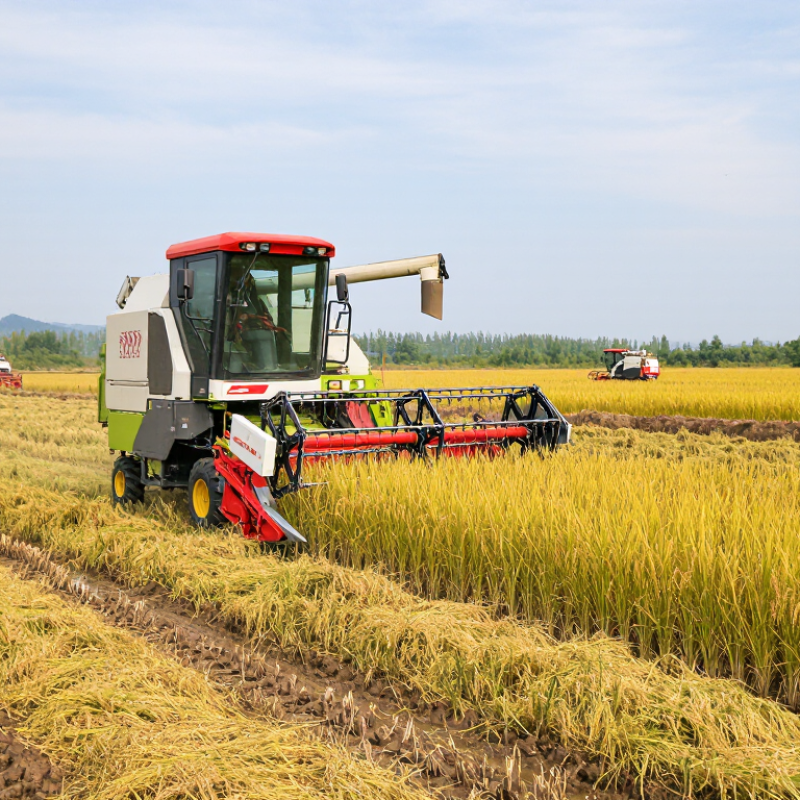
What Rice Harvesting Equipment Includes and How It Works
Rice harvesting equipment includes reapers, combine harvesters, threshers, and grain-handling tools. A reaper cuts standing rice but leaves threshing and cleaning for separate steps. A combine performs several jobs in one pass, cutting stalks, separating grain, and removing much of the chaff. The machine’s header gathers rice as its reel guides stalks toward the cutter bar. Inside, a threshing drum loosens the grains, while sieves and airflow separate them from straw and debris.
Timing matters. Rice is usually harvested when most grains have matured and the crop has dried enough for efficient cutting. If it is too wet, grain can be harder to thresh and may need more drying afterward. If harvest is delayed, ripe grains may fall from the panicles. At the field edge, operators check grain loss, sample moisture, and watch for clogged screens. Small details count.
Equipment choice depends on field size, soil firmness, plot shape, and access between rows. Large, level fields may suit a combine, while small or muddy plots can call for lighter machines or staged harvesting. Wet corners can slow even a capable harvester. Operators should adjust travel speed and threshing settings to limit broken grain and losses. A clean sample is useful, but it does not tell the whole story; fuel use, downtime, and grain quality matter too. Practical field notes help, though one season rarely reveals every weakness.
The Main Types of Rice Harvesters Used in 2026
Rice harvesting equipment in 2026 includes reapers, reaper-binders, and combine harvesters. A powered reaper cuts standing rice into rows, but threshing happens separately. It can suit small plots, narrow paths, and farms with limited machinery access. A reaper-binder also ties cut stalks into bundles, making them easier to collect or dry. Small plots matter.
Combine harvesters cut, thresh, and clean grain in one pass. Crawler-mounted models spread weight across soft, muddy paddies, while wheeled models can work well on firmer ground and between fields. Their size and turning space matter: a large machine may struggle on irregular plots or narrow field edges. It is not effortless.
The right type depends on field conditions, crop maturity, labor, and access to repairs. Check whether the machine can handle lodged rice, wet soil, and local field entrances. Grain moisture and cutting height affect losses, so operators should adjust settings and inspect the harvested grain. A combine may save time, yet its purchase and maintenance costs can be hard to justify on a very small farm. The choice is less obvious than it looks.
Key Factors for Choosing Rice Harvesting Equipment
Choosing rice harvesting equipment in 2026 starts with the field, not the machine’s advertised capacity. Measure plot size, access routes, and how soft the ground becomes after rain. Narrow, muddy paddies may suit a compact tracked harvester, while larger, firmer fields can accommodate wider machines. Traction matters. A machine that sinks or turns poorly can waste time and damage field edges.
Match the cutting width and harvesting speed to the crop and available labor. Check whether the equipment cuts cleanly at the rice height you expect, and ask how easily operators can adjust settings for lodging or uneven crop maturity. Grain loss and broken kernels deserve attention. If possible, compare samples collected during a field demonstration, rather than relying only on stated capacity. Small details count: visibility from the seat, access to service points, and how quickly the grain tank can be emptied.
Consider maintenance, spare-part access, fuel use, and operator training across the full season. A lower purchase price may not mean lower operating costs. There is no perfect machine, and that answer is not very satisfying. Still, testing equipment on representative ground can reveal problems that a brochure cannot. One limitation is easy to overlook: performance may change with soil moisture, crop density, and operator skill.
What Is the Best Rice Harvesting Equipment in 2026?
Compare estimated effective field capacity to identify equipment suited to your field size and harvesting needs.
How to read this chart: Rates are illustrative planning estimates, calculated as cutter width × operating speed × 70% field efficiency. Actual output varies with field layout, crop and soil conditions, rice lodging, operator skill, and turning or unloading time. When choosing equipment, also consider plot size, field access, grain handling, maintenance, and local service availability.
Which Rice Harvester Best Fits Different Farm Sizes and Conditions
FAOSTAT recorded about 776.5 million tonnes of paddy rice worldwide in 2022. That scale does not point to one best harvester. On small, irregular plots, a reaper or mini-combine turns easily and costs less to move between fields. A reaper still needs extra labor for bundling and threshing. Not ideal, sometimes.
For medium-sized farms, a compact combine often balances field speed, grain handling, and transport costs. Large, flat fields can justify a higher-capacity combine, especially when harvest windows are short. But capacity means little if access roads are narrow or grain trucks cannot keep pace. Wet paddies need another check: crawler tracks or low-ground-pressure tires can reduce bogging, though they may not solve deep, soft mud.
Harvest timing matters as much as machine size. IRRI’s Rice Knowledge Bank advises harvesting when roughly 80–85% of grains have turned straw-colored, with grain moisture around 20–25%. Compare that guidance with local conditions and the machine’s settings. I would not treat either figure as a guarantee; uneven ripening and rain can change the decision quickly. Check dealer-independent service access, parts availability, and field losses during a trial run before committing.
How to Compare Costs, Capacity, and Maintenance Needs
Choosing rice harvesting equipment in 2026 means comparing more than purchase prices. A compact reaper may suit small, fragmented plots, while a combine can cover larger fields faster. But advertised capacity rarely matches a full working day. Wet patches, lodged rice, narrow access roads, and grain unloading all reduce output. Ask local operators how many hectares they harvest daily in similar conditions. Details matter.
Compare total cost per hectare, not just the initial price. Include fuel, operator wages, transport, financing, seasonal storage, and expected repairs. Estimate annual costs against realistic hectares harvested, not an optimistic schedule. A lower-priced machine may cost more if it needs extra passes or causes avoidable grain loss. For equipment used only briefly, hiring a contractor may be worth comparing.
Maintenance needs can change the calculation. Check service intervals, spare-parts availability, and whether a mechanic can reach the machine during harvest. Before buying, inspect knives, belts, bearings, tires or tracks, and access to routine service points. Small delays add up. One estimate will still be wrong; harvest seasons rarely behave neatly. Record fuel use and downtime during a trial, then compare those figures with your own field conditions.
What Is the Best Rice Harvesting Equipment in 2026? — How to Compare Costs, Capacity, and Maintenance Needs
Planning guide for 2026. Purchase prices are broad indicative estimates in USD for new equipment; actual prices vary by country, configuration, dealer, and import costs. Field capacity is approximate and depends on crop yield, field size, soil conditions, lodging, and operator skill. Prices exclude taxes, transport, and attachments unless specified.
| Equipment type | Typical working width | Approx. field capacity | Indicative purchase price | Maintenance needs | Best fit |
| Walk-behind reaper | About 0.8–1.2 m | About 0.1–0.3 ha/hour | About $1,500–$5,000 | Frequent checks of blades, belts, fasteners, and engine oil; clean crop residue after use. Relatively simple repairs, but cutting parts need regular attention. | Small plots, tight field access, and farms seeking a low-cost alternative to hand cutting. Grain generally needs separate threshing. |
| Reaper-binder | About 1.0–1.5 m | About 0.2–0.5 ha/hour | About $4,000–$12,000 | Inspect cutting components, tying mechanism, belts, and drive parts; keep the knotter and binding system clean and correctly adjusted. Requires more attention than a basic reaper. | Small to medium fields where bundled rice is useful for drying, handling, or later threshing. |
| Compact combine harvester | About 1.2–2.0 m | About 0.2–0.6 ha/hour | About $15,000–$35,000 | Maintain engine, filters, belts, chains, cutter bar, threshing parts, and cleaning screens. Clean thoroughly after harvest to limit corrosion and rodent damage. | Small farms or fragmented fields that need cutting, threshing, and cleaning in one pass. |
| Mid-size combine harvester | About 2.0–3.5 m | About 0.5–1.2 ha/hour | About $40,000–$100,000 | Requires scheduled servicing of engine and hydraulic systems, plus inspection of threshing, separation, and grain-cleaning components. Wear-part costs and downtime planning matter. | Medium-sized operations or contractors working across several farms with reasonably accessible fields. |
| Large combine harvester | About 4.0–7.5 m | About 1.0–2.5 ha/hour | About $100,000–$250,000+ | Higher service and repair costs; needs trained operators, planned inspections, and reliable parts access. Transport between fields may require a trailer or header transport system. | Large, consolidated rice areas where high daily output can justify greater investment and operating costs. |
| Tracked combine harvester | About 1.5–4.0 m, depending on model | About 0.3–1.5 ha/hour | About $35,000–$150,000+ | All standard combine servicing applies, with additional inspection of tracks, rollers, tension, and undercarriage. Track repairs can be costly; clean mud from the undercarriage after field work. | Wet, soft, or poorly drained paddy fields where reduced ground pressure and traction are important. Capacity varies widely by machine size and field conditions. |


 Distributors
 SDS Download
 Contact
