
X

Partner Login

Enter your username and password here on order to log in on the partner portal:

No registered partner yet?

Register now

What Is the Best POY Spinning Line for Global Buyers?

Global buyers rarely choose a POY Spinning Line by catalog speed alone. The real decision begins with yarn targets, feedstock quality, factory conditions, and long-term service. A line producing stable polyester yarn must also handle product changes without excessive waste. Small details matter. Spinneret design, quenching airflow, winding tension, and online monitoring can shape daily output.

This guide examines what makes a POY Spinning Line dependable across different markets. It considers capacity, denier range, energy consumption, automation, installation support, spare parts, and operator training. Buyers should request trial data, not only polished brochures. Sample reports should show tenacity, elongation, interlace performance, dye consistency, and package appearance. Factory references can reveal more than a sales presentation. Ask how quickly a technician responds when a winder stops at 2 a.m.

Price still matters, but the lowest quotation may hide costly limitations. Weak documentation, delayed components, or difficult software access can reduce usable capacity. Local voltage, humidity, water quality, and building layout also deserve careful review. These issues are easy to overlook.

No single configuration fits every producer. A recycled-material project may need different filtration and drying controls. A high-volume plant may value uptime over maximum flexibility. Even experienced teams can misjudge maintenance skills or future product plans. That uncertainty deserves honest discussion. This outline compares technical performance, supplier credibility, lifecycle cost, and practical risk, helping global buyers choose with evidence rather than attractive claims.
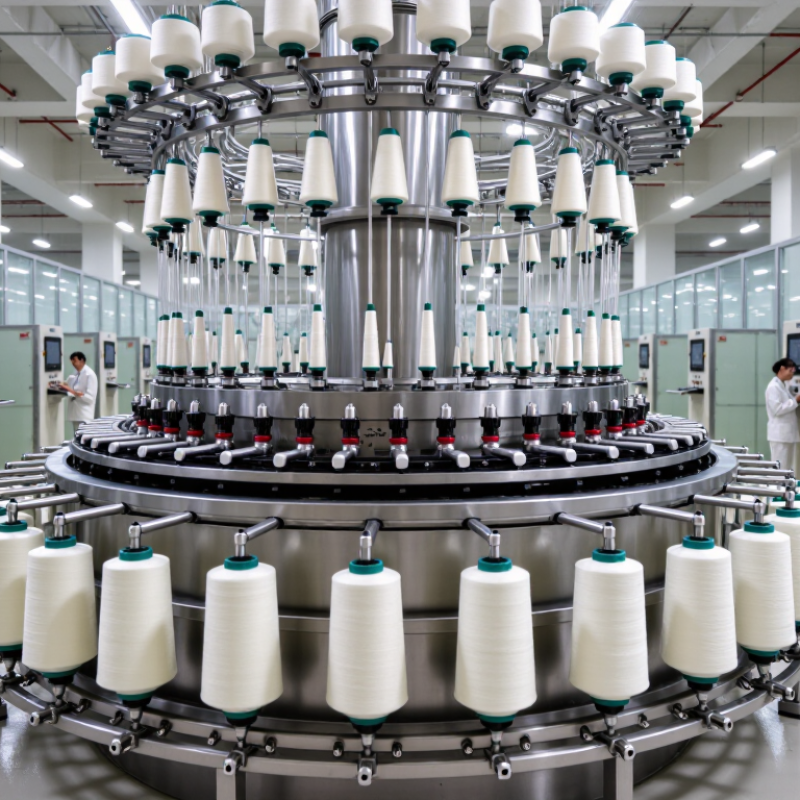
What Is the Best POY Spinning Line for Global Buyers?

POY Spinning Line Fundamentals and Core Production Stages

A POY spinning line converts polymer chips into partially oriented yarn through controlled melting, filtration, extrusion, cooling, drawing, and winding. The process begins with drying. Moisture can reduce polymer viscosity and create unstable spinning.

The polymer then enters an extruder and passes through a melt filter. A spinning pack shapes the melt through precision spinnerets. Quench air cools the fresh filaments evenly. Small temperature differences matter. Operators monitor air velocity, melt pressure, and filament breaks continuously. Godet rollers control yarn speed and tension before automatic winders form stable packages. Modern POY production commonly runs above 2,500 meters per minute, although actual speed depends on polymer quality, denier, and equipment design.

Market scale makes process discipline important. Textile Exchange’s Materials Market Report 2024 estimated global fiber production at 124 million tonnes in 2023, with polyester representing about 57%. This demand does not make every high-speed line suitable. A global buyer should examine energy use, filter-change intervals, package consistency, and maintenance access. The International Textile Machinery Federation also emphasizes automation, efficiency, and reliable process control in modern filament production.

One detail is often underestimated: cooling uniformity. Poor quench balance can produce uneven dye uptake later. A line may look efficient during a factory visit, yet its long-term waste rate remains unclear. Buyers should request production records, yarn evenness data, and trial packages under real operating conditions. Specifications alone are not enough.

Key Equipment in a High-Performance POY Spinning Line

What Is the Best POY Spinning Line for Global Buyers?

A high-performance POY spinning line begins with stable polymer preparation. The extruder must maintain accurate melting temperatures and steady pressure. A reliable metering pump then controls polymer flow into each spinning position. Small flow variations can create denier differences across the package. This matters because Textile Exchange’s 2024 Materials Market Report recorded polyester at about 57% of global fiber production in 2023. Large demand makes consistency more valuable than impressive machine speed.

The spinning beam, spinnerets, and quenching system directly shape filament quality. Uniform cooling prevents uneven orientation and reduces broken filaments during winding. In practice, I would inspect airflow distribution with actual temperature mapping, not only accept catalog values. A few degrees can change yarn performance. Precision godets should provide stable tension, while the winder needs accurate traverse control and package density. Poor winding may remain hidden until downstream texturing.

Energy monitoring and process data deserve equal attention. The International Energy Agency continues to identify industrial efficiency as a major route for reducing manufacturing energy demand. Therefore, buyers should request power consumption per kilogram of POY, not just installed motor capacity. Closed-loop controls can connect temperature, pressure, speed, and tension records. Useful alarms should identify drift before operators see defects. This sounds obvious. It is still often missed. A thoughtful acceptance test should include long-hour operation, startup waste, package inspection, and maintenance access. The best line is not always the fastest; it is the one that delivers repeatable yarn with measurable operating discipline.

How to Evaluate POY Line Capacity, Quality, and Energy Efficiency

What Is the Best POY Spinning Line for Global Buyers?

A strong POY line should be judged by verified output, not brochure capacity. Textile Exchange’s Materials Market Report 2024 estimates that polyester represented about 57% of global fiber production in 2023. This scale increases pressure on consistency, uptime, and operating cost. Ask suppliers for tested kilograms per hour, denier range, filament count, and first-pass yield. A line rated at 1,200 kg/h may deliver less after polymer changes, filter replacement, or frequent doffing. Real factory data matters more.

Energy efficiency needs close measurement. The International Energy Agency reported that industry used about 37% of global final energy in 2022. For POY, buyers should track kilowatt-hours per kilogram across extrusion, spinning pumps, quenching, winding, and compressed air. Request twelve months of electricity records, not one laboratory reading. Check motor efficiency, heat recovery, automatic tension control, and standby consumption. Small losses become expensive at continuous production.

Look beyond the headline number. A reliable acceptance test should record yarn strength, elongation, evenness, oil pickup, and package hardness. Samples should be tested during start-up and stable production. ISO-based laboratory procedures improve comparison between suppliers. Still, no test is perfect. Ambient temperature, polymer quality, and operator skill can distort results. I would also inspect maintenance access, spare-part response, and control-system alarms. Downtime hides in ordinary details. A clean layout helps, but it does not guarantee efficiency.

Automation, Safety, and Maintenance Requirements for Global Buyers

The best POY spinning line for global buyers is not simply the fastest option. It must deliver stable yarn quality under different climates, power conditions, and operator skill levels. Automation should control spinning speed, temperature, winding tension, and package formation with minimal manual adjustment. Central data collection helps engineers trace alarms, production changes, and quality deviations.

Safety must be built into the line, not added after installation. Guards should cover rotating and heated areas, while interlocks prevent access during operation. Clearly positioned emergency stops are essential. A reliable line also needs safe procedures for threading, cleaning, and material changes. Training should include realistic fault scenarios, not only classroom instructions. Small details matter.

Maintenance requirements often decide long-term value. Buyers should examine access to filters, pumps, heaters, sensors, and winding units before purchasing. Predictive monitoring can identify abnormal vibration or temperature early. However, excessive automation may hide simple mechanical problems. That risk deserves attention. Spare parts should have clear identification, storage guidance, and reasonable replacement intervals. Remote support is useful, but local technicians still need practical manuals and hands-on training. A maintenance plan that looks perfect on paper may fail during a night shift, when one sensor fault stops the entire line.

What Is the Best POY Spinning Line for Global Buyers? — Automation, Safety, and Maintenance Requirements
Evaluation Area Key Requirement Standard POY Line Automated POY Line High-Flexibility POY Line
Production Capability Typical winding speed Up to approximately 3,000 m/min, depending on polymer, denier, and process design. Approximately 2,500–3,600 m/min with broader product-change flexibility.
Production Capability Filament-position configuration Commonly 48–96 positions per spinning unit. Typically 48–144 positions to balance capacity and product variety.
Product Quality Tension and denier control Central process control with manual verification and operator adjustments. Enhanced recipe management for frequent changes in denier, luster, and cross-section.
Automation Control architecture PLC-based line control with a local HMI and manually coordinated operating steps. Modular control system designed for multiple product recipes and rapid changeovers.
Automation Winder doffing and package handling Manual or semi-automatic doffing; higher labor requirement and greater variation between shifts. Semi-automatic or automatic handling selected according to package size and product mix.
Automation Data and traceability Basic production records; quality data may require manual entry. Digital traceability focused on product changes, trial runs, and quality comparison.
Safety Machine safeguarding Fixed guards, access doors, emergency-stop devices, and operator procedures. Safeguarding adapted to frequent access during product changeovers and laboratory trials.
Safety Recommended design framework Risk assessment based on ISO 12100 and electrical safety practices based on IEC 60204-1. The same core standards, with additional procedures for changeover, sampling, and maintenance access.
Safety Thermal and polymer-handling protection Insulation, warning labels, guarded hot surfaces, and manual lockout procedures. Additional protection and access controls for frequent experimentation and material changes.
Energy and Utilities Energy monitoring Main electrical consumption measured at plant or line level. Monitoring prioritized for comparing recipes, polymers, and operating conditions.
Energy and Utilities Compressed-air requirement Requires stable, filtered, and dry plant air; consumption depends on pneumatic devices and handling equipment. Utility demand varies with the selected winding, handling, and changeover systems.
Maintenance Daily operator checks Cleanliness, yarn path, oil levels, package build, abnormal noise, and visible leakage. The same checks with additional inspection of changeover tools and product-specific components.
Maintenance Preventive-maintenance planning Time-based maintenance supported by operator logbooks and periodic inspections. Scheduled maintenance must account for more frequent product changes and trial conditions.
Maintenance Critical spare parts Mechanical bearings, belts, heaters, sensors, drives, fuses, and common pneumatic parts. Broader inventory may be needed because of the greater number of product-specific components.
Maintenance Troubleshooting capability Local technician diagnosis using drawings, manuals, and measured process conditions. Detailed documentation is essential because faults may be linked to recipe or material changes.
Workforce Training requirement Operator training focused on process control, yarn handling, package quality, and basic safety. Additional training is required for recipe management, trials, and rapid product changeovers.
Global Deployment Remote support readiness Primarily dependent on manuals, photographs, phone support, and local service resources. Remote support should include recipe review, process-history analysis, and changeover guidance.
Global Deployment Recommended acceptance tests Dry run, safety-device test, output verification, package inspection, and basic quality sampling. Acceptance tests should include several product recipes and documented changeover performance.
Buyer Suitability Best fit Cost-focused operation
Suitable where labor is available and product variety is limited.
Flexible production
Suitable for plants producing multiple specifications or developing new POY products.
Data basis: The figures and practices shown are indicative industry benchmarks for polyester POY spinning projects. Actual performance, position count, utility consumption, maintenance intervals, and automation scope depend on polymer characteristics, denier range, plant design, local regulations, selected process technology, and the buyer’s acceptance criteria.

Choosing the Best POY Spinning Line for Different Markets and Fibers

What Is the Best POY Spinning Line for Global Buyers?

Choosing the Best POY Spinning Line for Different Markets and Fibers

The best POY spinning line depends on fiber type, target denier, local power stability, and customer demand. A polyester line for fine apparel yarn may require precise temperature control and stable high-speed winding. A line for industrial yarn needs stronger tension control and greater output consistency. Nylon POY also demands careful polymer handling because moisture can affect spinning performance.

Market conditions matter. A hot, humid factory may need stronger air-conditioning and humidity control. In regions with unstable electricity, efficient drives and backup systems can protect production. Buyers should review actual energy use, maintenance access, spare-part availability, and operator training. I have seen projects focus heavily on speed, then struggle with waste during frequent product changes. Faster is not always better.

Tips: Test the line with your own polymer and planned denier range. Request trial data, winding-quality records, and long-run stability results. Check whether technicians can respond quickly in your region. Small details matter. Also, leave room for future fibers or package sizes. This can increase the initial investment, but it may prevent an expensive upgrade later. A practical selection should balance output, quality, flexibility, and the factory’s real working conditions.