
Partner Login
Enter your username and password here on order to log in on the partner portal:
No registered partner yet?
Register nowChoosing the right Aramid Honeycomb Tools requires more than comparing prices or catalog images. Global buyers must examine core density, cell size, foil thickness, cutting accuracy, and heat resistance. A tool that looks precise may still create crushed cells, uneven edges, or weak bonding surfaces.
Dr. Stephen W. Tsai, a widely cited composites researcher, has stated, “A material is only as good as the design that uses it.” This principle also applies to Aramid Honeycomb Tools. Their performance depends on the complete process, including machining speed, dust extraction, adhesive selection, storage conditions, and operator experience. Small details matter. A dull cutting edge can deform a lightweight core within seconds.
The 2026 market includes trimming tools, profiling systems, drilling equipment, routing solutions, and customized fixtures for aerospace, marine, rail, automotive, and wind-energy applications. Buyers should request technical datasheets, dimensional tolerances, sample results, and batch-traceability records. Independent testing is even better. Supplier claims are not enough.
Still, no purchasing guide can remove every risk. Tool life changes with core density and production volume. Local service may also be weaker than expected. This guide reviews leading Aramid Honeycomb Tools through practical criteria, not promotional language. It considers accuracy, durability, operator safety, compatibility, and long-term value. Some rankings may remain debatable. That is useful. Careful buyers should challenge them.
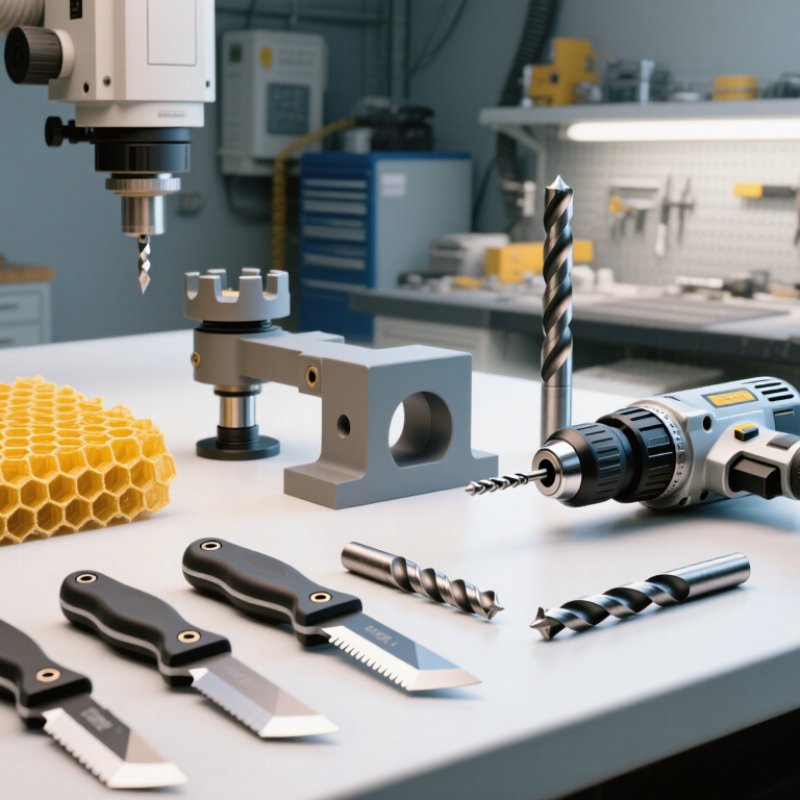
2026 Top Aramid Honeycomb Tools for Global Buyers
Aramid honeycomb is a lightweight core made from aramid paper and resin. The paper is bonded into hexagonal cells, then expanded into a rigid panel. This structure creates high stiffness with surprisingly low weight. A technician can lift a large tooling board without using a crane. That matters when molds, jigs, and layup tools move between workstations.
Tooling teams use aramid honeycomb inside sandwich panels. Composite skins carry surface loads, while the core supports the distance between them. The result is a stable, low-mass tool for aerospace, marine, rail, and industrial production. It also resists fatigue better than many ordinary foam cores. Smooth cell geometry helps produce uniform bonding, but only when adhesive flow is controlled. Too much resin adds weight. Too little resin creates weak areas.
Selection requires more than comparing density. Buyers should check cell size, thickness, resin type, surface treatment, and operating temperature. The final tooling limit depends on the core, skins, adhesive, and curing cycle together. Experienced engineers request test data and inspect sample panels before approving volume orders. Small voids can appear near edges or inserts. They are easy to miss. Aramid honeycomb is not perfect, and machining can expose fragile cells. Careful sealing, clean cutting, and controlled storage reduce these problems, though they do not remove them completely.
Aramid honeycomb tooling combines a lightweight core with bonded skins. Its cells carry shear loads, while the skins resist bending. This creates stiff panels without excessive mass. In aerospace, technicians use these panels for layup tables, drilling fixtures, vacuum-bagging tools, and lightweight molds. MarketsandMarkets reported that the global aerospace composites market could reach about USD 57 billion by 2029. That growth increases demand for stable, reusable tooling.
Automotive engineers use aramid honeycomb tools for prototype panels, roof structures, and interior components. The low thermal mass supports faster heating and cooling cycles. In rail vehicles, large floor and wall tools help control panel flatness during bonding. Marine fabricators also value moisture-resistant cores, though sealing quality remains critical. Small leaks can ruin an otherwise precise tool. The 2024 Lightweight Materials report from the U.S. Department of Energy identifies mass reduction as a continuing priority for transport efficiency.
Tool performance depends on cell size, resin compatibility, skin thickness, and machining accuracy. Cutting should use sharp carbide tooling and controlled feeds. Excessive heat can damage the core edge. Industry guidance from SAE composite tooling practices stresses dimensional stability during repeated temperature changes. Still, published strength values vary widely between constructions. Buyers should test the complete sandwich panel, not only the core sheet. This is where many specifications become too optimistic. Actual workshop conditions matter more than a clean laboratory table.
Aramid honeycomb cores are selected according to the required balance of weight, stiffness, impact resistance, fire performance, and environmental durability. The representative density grades shown here are commonly used engineering ranges for lightweight sandwich panels; final specifications depend on cell size, resin system, facing material, and structural load requirements.
Top aramid honeycomb tools combine low weight, controlled stiffness, and dependable surface quality. Aramid paper cores suit aerospace panels, molds, and inspection fixtures because they resist fatigue and many common chemicals. Phenolic resin improves heat resistance and dimensional stability. However, resin content must be balanced carefully. Excess resin adds weight and can reduce the core’s flexibility.
Design matters as much as material selection. Smaller cells provide better support for thin skins and curved surfaces. Larger cells reduce weight but may print through under pressure. Tooling panels usually need bonded face skins, sealed edges, and local inserts around fasteners. CNC machining should use sharp cutters and controlled feed rates. Dust extraction is essential. A polished surface alone does not guarantee accurate parts.
Tips: Confirm cell size, core density, thickness, resin system, and operating temperature before ordering. Request test data for compression, shear, and thermal cycling. Check flatness after bonding, not only before it. In practical trials, the lightest design is not always the most stable. That assumption deserves review. Slightly higher density may prevent vibration, edge damage, and repeated repairs. Also inspect joints and corners closely; failures often begin there, not across the main panel.
| Tooling Design / Core Type | Typical Aramid Material | Nominal Cell Size | Typical Core Density | Common Core Thickness | Key Performance Feature | Suitable Tooling Use | Recommended Face-Sheet Design | Relevant Test Methods |
|---|---|---|---|---|---|---|---|---|
| Lightweight flat tooling panel | Meta-aramid paper impregnated with heat-resistant phenolic resin | 3.2–6.4 mm | 32–64 kg/m³ | 10–25 mm | Very low mass with good in-plane stability | Temporary assembly jigs, inspection boards and lightweight workholding panels | Thin glass-fiber/epoxy or carbon-fiber/epoxy skins bonded on both sides | ASTM C365/C365M, ASTM C393/C393M |
| High-temperature composite fixture | Meta-aramid paper with phenolic resin system selected for elevated-temperature service | 3.2–9.5 mm | 48–96 kg/m³ | 15–40 mm | Low thermal conductivity and good resistance to flame-related degradation | Composite curing supports, thermal shields and elevated-temperature positioning fixtures | Glass-fiber/epoxy skins for moderate temperatures; high-temperature laminate skins when required | ASTM C177, ASTM C518, ASTM C365/C365M |
| High-shear sandwich tool | Higher-density meta-aramid honeycomb with controlled resin content | 3.2–6.4 mm | 64–128 kg/m³ | 20–50 mm | Higher shear and compression capability than low-density cores | Large-format drilling fixtures, machining supports and transportable assembly tables | Balanced laminate skins with local solid inserts beneath clamps and fasteners | ASTM C273/C273M, ASTM C365/C365M, ASTM C393/C393M |
| Curved or contoured tooling shell | Flexible aramid honeycomb manufactured in formed or segmented sections | 3.2–12.7 mm | 32–80 kg/m³ | 10–30 mm | Conforms to single-curvature and selected double-curvature surfaces | Aerodynamic patterns, curved trim fixtures and shell-style composite molds | Thin conformable skins with edge close-outs and perimeter frames | ASTM C393/C393M, ASTM C364/C364M |
| Vacuum-compatible tooling board | Aramid paper honeycomb with sealed cells and low-permeability face skins | 3.2–6.4 mm | 48–96 kg/m³ | 15–35 mm | Good stiffness-to-weight ratio when cell edges and panel perimeter are sealed | Vacuum-bagging tables, debulk fixtures and composite lay-up supports | Continuous fiber skins with sealed edges, ports and threaded hard points | ASTM C393/C393M, ASTM E595 where outgassing is specified |
| Impact-resistant service fixture | Aramid honeycomb combined with toughened fiber-reinforced polymer skins | 6.4–12.7 mm | 64–128 kg/m³ | 20–50 mm | Improved damage tolerance and energy absorption compared with thin flat skins | Reusable maintenance fixtures, protective covers and handling tools | Toughened glass-fiber or hybrid fiber skins with radiused edges | ASTM C393/C393M, ASTM D7766, ASTM D7136/D7136M |
| Precision modular tooling platform | High-density aramid honeycomb with machined perimeter frames and embedded hard points | 3.2–6.4 mm | 80–160 kg/m³ | 25–60 mm | High panel stiffness and repeatable attachment-point performance | Modular assembly tables, metrology supports and repeat-production fixtures | Stiff balanced skins, aluminum or composite perimeter frames, and bonded inserts | ASTM C365/C365M, ASTM C273/C273M, ASTM C393/C393M |
Global buyers should compare aramid honeycomb tools through measurable evidence, not catalog claims. A 2024 aerospace composites market report by MarketsandMarkets forecasts annual growth above 8% through the decade. That growth attracts more suppliers, but quality remains uneven. Request density, cell size, foil thickness, resin type, and batch traceability. Ask for recent test reports, not selected samples. ASTM C365/C365M supports flatwise compression testing, while ASTM C393/C393M evaluates sandwich flexural performance. These standards make supplier comparisons less subjective.
Pricing needs a wider lens. A low quotation may exclude tooling design, protective packaging, export documentation, or minimum-order charges. Calculate cost per usable square meter, including rejected pieces and machining time. Suppliers meeting ISO 9001 controls usually provide clearer inspection records, but certification alone proves little. Check whether their process covers incoming paper, adhesive curing, expansion, and final dimensional inspection. FAA AC 20-107B also offers useful guidance for aerospace composite substantiation, even when the product serves another industry. I still verify every claim with an independent laboratory. Mistakes happen.
For practical trials, order matching samples from three regions and test them under identical humidity and temperature conditions. Record thickness recovery, edge damage, bonding behavior, and cutting dust. A 2023 composite manufacturing survey reported that process consistency and material traceability remain major purchasing concerns. Freight distance can reduce pricing advantages quickly. Buyers should also compare lead times, replacement policies, engineering support, and communication speed. The best supplier is not always the cheapest. Sometimes, the spreadsheet exposes that uncomfortable truth.
Before importing aramid honeycomb tools, buyers should confirm the exact construction and working purpose. “Tooling” can mean a lightweight mold, support fixture, or machined sandwich component. Ask for core type, cell size, density, thickness, surface finish, and dimensional tolerance. These details affect stiffness, cutting accuracy, and service life.
Request a current technical data sheet and batch-level inspection report. Check compression strength, shear performance, resin compatibility, moisture condition, and allowable temperature range. A small sample can reveal crushed cells, uneven bonding, or poor edge trimming. Inspect it under side lighting. Defects often hide in flat-looking panels.
Supplier reliability also needs evidence. Review production records, traceability procedures, packaging photos, and previous export experience. Confirm whether the tools are shipped flat, sealed, and protected from impact. Ask for export documents, a commercial invoice, packing list, and accurate customs classification support. Use a qualified customs professional for local requirements. Do not rely on copied certificates.
Costs can change after arrival. Include machining, inspection, freight, insurance, duties, and possible replacement pieces. A written acceptance standard should define flatness, visible defects, dimensions, and rejection handling. My own caution is simple: a low quoted price may hide weak inspection or unsuitable resin bonding. No checklist is perfect. Recheck critical measurements after unpacking, especially when the shipment has crossed humid regions or experienced temperature changes.